You’re writing about changing the color of a shirt, and you type “dying my hair.” Something feels off. Shouldn’t there be an “e” in there somewhere? You check again, and now you’re worried you accidentally wrote something about death instead of hair color.
This is one of the most important spelling mix-ups in English, because getting it wrong doesn’t just look like a typo, it can completely change the meaning of your sentence. People search for this constantly while writing about crafts, hair color, fabric, fashion, or even news stories, since one letter separates a harmless hobby from something much more serious.
The confusion happens because “dye” and “die” are already easy to mix up on their own, and adding “-ing” makes it worse. Both words follow different spelling rules when forming their continuous tense, and English doesn’t make it obvious why.
This article gives you a clear, simple answer, explains the spelling rule behind it, and shows you exactly how to avoid this mistake for good, no matter what you’re writing about.
Dyeing or Dying Quick Answer

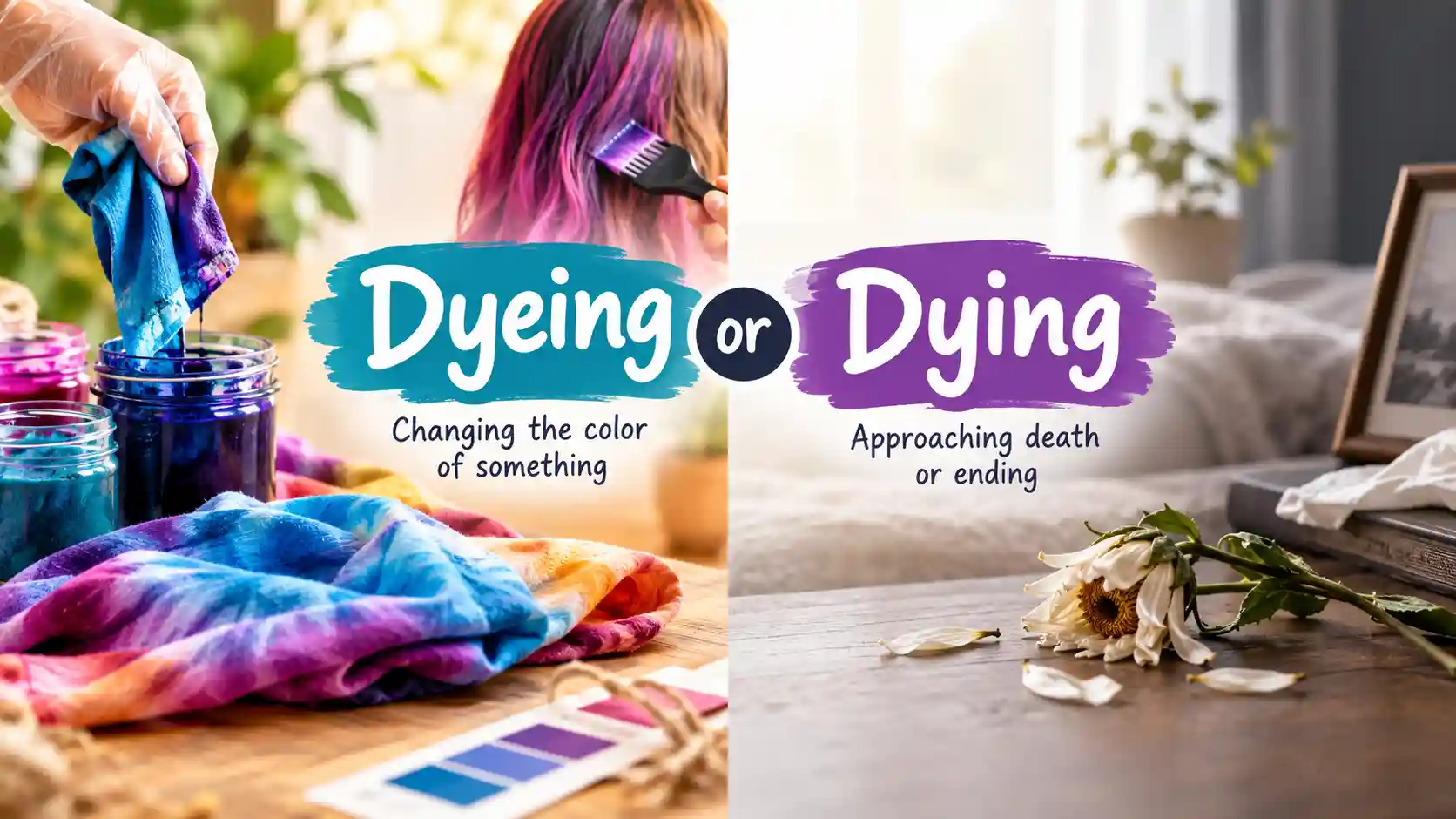
“Dyeing” and “dying” are two completely different words. They are not interchangeable.
- Dyeing means changing the color of something, like fabric, hair, or fibers.
- “She spent the afternoon dyeing the curtains a deep shade of blue.”
- Dying means approaching death or ceasing to exist.
- “The plant is dying from lack of water.”
One letter, the “e,” makes all the difference. Leave it out, and your sentence about hair color suddenly sounds much darker than you intended.
The Origin of Dyeing and Dying

Both words come from completely separate roots in Old English, and their spelling difference exists specifically to keep them distinct from each other.
“Dye” comes from the Old English word deagian, meaning to color or stain something. When adding “-ing” to form the continuous tense, English normally drops the silent “e” (like “make” becoming “making”). But dropping the “e” in “dye” would create “dying,” an existing word with a completely different meaning. So English made an exception here, keeping the “e” to form “dyeing” and avoid confusion.
“Die” comes from the Old Norse word deyja, meaning to lose life. Following the standard English rule, the silent “e” is dropped before adding “-ing,” turning “die” into “dying.”
This is a rare case in English where a spelling rule was deliberately bent to prevent two unrelated words from becoming identical. Without that extra “e” in “dyeing,” craft tutorials and hair color blogs would read very differently.
British English vs American English Spelling
There is no regional spelling difference here. Both American and British English use “dyeing” and “dying” in exactly the same way, with the same spelling rule applying in both dialects.
| Word | American English | British English |
|---|---|---|
| Approaching death (continuous) | dying | dying |
| Base verb: color | dye | dye |
| Base verb: death | die | die |
Since this distinction is about meaning, not regional preference, there’s no US-versus-UK debate to consider. Both dialects follow the identical rule.
Which Word Should You Use?
- US writers: Use “dyeing” for coloring fabric, hair, or materials. Use “dying” for anything related to death or ending.
- UK and Commonwealth writers (UK, Australia, Canada, India): The exact same rule applies. There is no regional variation to account for.
- Global and academic writers: Focus entirely on meaning. If you’re describing a color change, always keep the “e”: dyeing. If you’re describing the end of life, drop it: dying.
A simple memory trick: “dyeing” keeps the “e” from “dye,” just like the color process keeps the fabric’s new look. “Dying” drops the “e,” just like life eventually comes to an end.
Common Mistakes with Dyeing and Dying

- Dropping the “e” when writing about color : Writing “I’m dying my hair” instead of the correct “I’m dyeing my hair” is one of the most common errors online.
- Adding the “e” when writing about death : Writing “dyeing of thirst” instead of the correct “dying of thirst.”
- Assuming spellcheck will catch it : Both words are spelled correctly on their own, so spellcheck often won’t flag the mistake if it’s used in the wrong context.
- Confusing “dye” and “die” as root words : Remembering that “dye” relates to color and “die” relates to death helps prevent errors in both the base word and the “-ing” form.
- Using the wrong word in captions or headlines : Craft, beauty, and fashion content frequently misspells “dyeing” as “dying,” which can look alarming or confusing out of context.
Dyeing and Dying in Everyday Examples
In emails: “I’ll be dyeing the fabric samples this afternoon and will send updated photos by tomorrow.”
In news: “Local textile workers are reviving traditional dyeing techniques using natural plant-based pigments.”
social media: “Spent my Saturday dyeing this old denim jacket a totally new color. Obsessed with how it turned out!”
In formal writing: “The study examined the environmental impact of industrial fabric dyeing processes on nearby water sources.”
Dyeing or Dying Google Trends & Usage Data

Search interest in “dyeing or dying” stays fairly consistent year-round, driven largely by craft enthusiasts, hair color tutorials, and fashion content creators searching for the correct spelling before posting. Interest often rises around seasonal trends, like tie-dye crafts in summer or hair color changes tied to season or holiday trends.
The United States, United Kingdom, and Australia all show similar search patterns, since this is a universal spelling distinction rather than a regional one. Beauty and fashion blogs, DIY craft sites, and textile industry publications are among the most common sources using “dyeing” correctly, while casual social media posts show the highest rate of the common “dying” misspelling.
Keyword Variation Comparison Table
| Variation | Meaning | Common Use |
| Dyeing | Changing color (continuous tense) | Fabric, hair, crafts |
| Dying | Approaching death (continuous tense) | Health, news, literature |
| Dye | Base verb/noun for coloring | Hair color, fabric dye |
| Die | Base verb for death | General usage |
FAQs
1. What is the difference between “dyeing” and “dying”?
“Dyeing” means changing the color of something, while “dying” means approaching death or ending.
2. Is “I’m dying my hair” correct?
No. The correct phrase is “I’m dyeing my hair,” referring to changing hair color.
3. Why does “dyeing” keep the “e” while “dying” drops it?
English normally drops the silent “e” before adding “-ing,” but “dyeing” keeps it specifically to avoid being confused with “dying.”
4. How can I remember which spelling to use?
Remember that “dyeing” keeps the “e” from “dye” (color), while “dying” drops the “e” from “die” (death).
5. Does British English spell these words differently than American English?
No. Both American and British English use “dyeing” and “dying” the exact same way, with no regional variation.
6. Is this a common mistake?
Yes, it’s one of the most frequently confused word pairs in English, especially in casual writing, captions, and social media posts.
7. Can spellcheck catch this mistake?
Not always. Since both words are spelled correctly on their own, spellcheck often won’t flag the error if it’s used in the wrong context.
Conclusion
“Dyeing” and “dying” differ by just one letter, but that single “e” carries an enormous difference in meaning. “Dyeing” refers to changing the color of something, like fabric or hair, while “dying” refers to approaching death or the end of something. The “e” in “dyeing” is deliberately kept in English spelling specifically to avoid confusion with the much more serious “dying.”
This isn’t a regional spelling difference between American and British English, both dialects follow the exact same rule. The real key to getting it right is remembering the connection to each word’s root: “dye” for color, “die” for death.
Whether you’re writing about a craft project, a hair color change, a news story, or a personal reflection, taking a second to double-check this spelling can prevent a genuinely confusing or awkward mistake in your writing.

Zainab Noor is a passionate content writer specializing in grammar and English language topics. With 2 years of experience, she creates clear, engaging, and SEO-friendly content that helps readers understand grammar, improve their writing skills, and use English with greater confidence.