Writing a sentence such as “James’s car” or “James’ car” can make even confident writers stop and think. Both forms are common, and both can be found in published English. So, which one should you use?
The confusion comes from the fact that James already ends in s. English has more than one style for forming the possessive of a singular name ending in s, especially when the name is pronounced with a final z sound. Some style guides recommend adding ’s, while others allow or prefer an apostrophe alone. That is why you may see both James’s and James’ in books, newspapers, websites, and formal documents.
The key is consistency. James’s is widely accepted and follows the general rule for singular possessive nouns. James’ is also accepted by several major style systems, particularly in some journalistic and organizational styles.
In this guide, you will learn the difference between James’s or James’, their history, British and American usage, common mistakes, everyday examples, and practical advice for choosing the right form.
James’s or James Quick Answer

Both James’s and James’ can be correct when showing possession by one person named James.
James’s
He follows the common rule of adding ’s to a singular noun or name.
- James’s car is parked outside.
- I borrowed James’s book.
- James’s sister lives nearby.
James’
James’ uses only an apostrophe after the final s.
- James’ car is parked outside.
- I borrowed James’ book.
- James’ sister lives nearby.
Which should you choose?
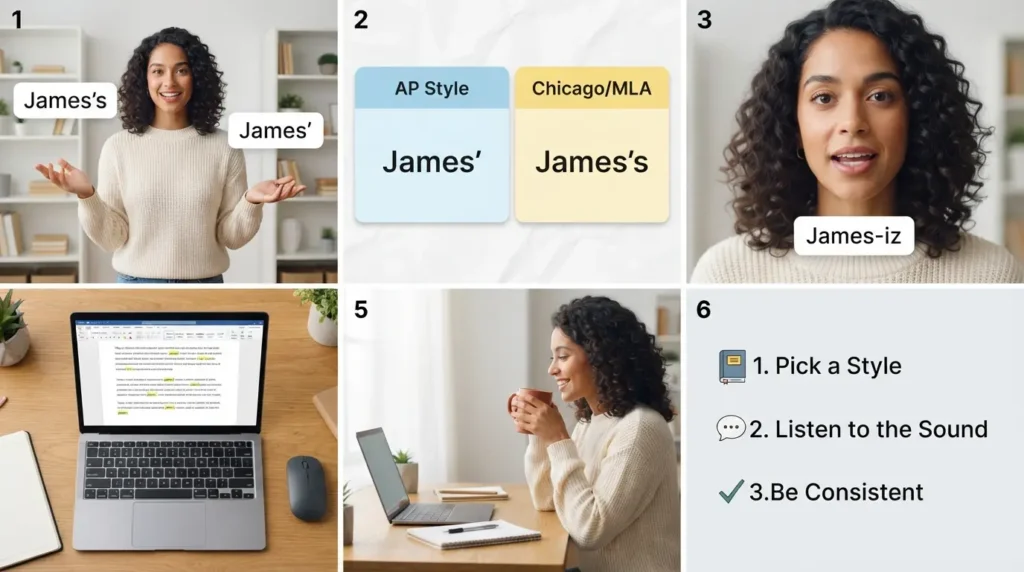
For general writing, James’s is a clear and widely accepted choice. The Chicago Manual of Style recommends adding ’s for singular proper names, including names ending in s.
However, some style guides use James’. For example, AP style generally omits the additional s for singular proper names ending in s.
Simple rule: If your style guide does not specify otherwise, James’s is a safe and widely accepted choice.
The Origin of James’s and James

The difference between James’s and James’ comes from the history of English possessives and changing style conventions.
In Old English, possession was often shown by changing the ending of a noun. Over time, English moved toward using apostrophe-based possessive forms. The apostrophe eventually became an important marker for possession and omitted letters.
Today, the possessive of a singular noun usually takes ’s:
- child → child’s
- teacher → teacher’s
- James → James’s
But names ending in s created a style question. Writers began using either ’s or an apostrophe alone, especially because James’s can look unusual and may create a repeated s sound.
Modern style guides therefore differ. Chicago recommends James’s, while AP style generally uses James’ for singular proper names ending in s.
This means the two forms are not simply spelling errors. They reflect different style conventions.
British English vs American English Spelling
The choice between James’s and James’ is not a simple British-versus-American spelling difference. Both forms can appear in both varieties of English.
American style guides differ among themselves. Chicago style uses James’s, while AP style uses James’ for singular proper names ending in s.
British English also commonly uses James’s, although individual publishers and style guides can have their own preferences.
| Feature | American English | British English |
| James’s | Accepted | Accepted |
| James’ | Accepted in some styles | Accepted in some styles |
| Common general rule | Singular names often take ’s | Singular names often take ’s |
| Major style variation | Yes | Yes |
| Main issue | Style guide preference | Style guide preference |
Examples
James’s bicycle
This follows the ’s approach.
James’ bicycle
This follows the apostrophe-only approach.
Neither should automatically be called a spelling mistake. The correct choice depends on the style guide you are following.
Which Spelling Should You Use?
Your audience matters less than the style guide or organization you are writing for.
For general writing
Use James’s if you do not have a specific style requirement. It clearly shows that James owns or is associated with something.
James’s phone is on the table.
For academic writing
Check your school’s or institution’s preferred style guide. If it follows Chicago style, James’s is normally preferred.
For journalism
If you are following AP style, use James’ for a singular proper name ending in s.
James’ statement was released on Monday.
For British or Commonwealth readers
James’s is widely understood and commonly used. However, publishers may follow their own house style.
For global English
The safest approach is to choose one recognized style and use it consistently throughout your document.
Most important: Do not switch randomly between James’s and James’ in the same piece of writing.
Common Mistakes with “James’s or James’”
1. Removing the apostrophe completely
Incorrect:
James’ book is on the table.
Correct:
James’s book is on the table.
Or, under an apostrophe-only style:
James’ book is on the table.
2. Adding only an apostrophe without considering style
Some writers assume James’ is always correct because the name ends in s. That is not true. Many style guides prefer James’s for singular names.
3. Assuming James’s is always wrong
It is not. James’s is a standard possessive form under many style systems.
4. Confusing singular and plural possessives
- James’s car = the car belonging to one James
- the Jameses’ house = the house belonging to a family named Jameses
5. Mixing styles
Avoid writing:
James’s car was beside James’ office.
unless there is a specific reason for the different forms.
Choose a style and stay consistent.
James’s or James’ in Everyday Examples
In Emails
I have attached James’s report for your review.
Or, under AP style:
I have attached James’ report for your review.
In News Writing
A publication following AP style may write:
James’ comments attracted attention online.
A publication following another style may write:
James’s comments attracted attention online.
The difference is based on editorial style, not a change in meaning.
On Social Media
Happy birthday to James! Hope you have an amazing day!
When possession is needed:
James’s new project looks fantastic!
Social media does not normally require a special possessive system, so James’s is a straightforward choice.
In Formal Writing
James’s research provides useful information about the topic.
In a formal document, follow the required institutional style guide.
James’s or James’ Google Trends & Usage Data

People commonly search “James’s or James’” because both forms appear in real English. Search interest is usually connected to grammar lessons, proofreading, academic writing, journalism, and questions about possessive apostrophes.
The main reason for the confusion is that different style guides make different recommendations.
Chicago style recommends James’s for singular proper names ending in s. AP style generally recommends James’.
Search interest can also vary by country, school system, profession, and writing context. For example:
- United States: searches often relate to AP, Chicago, academic writing, and grammar.
- United Kingdom: searches often relate to general possessive rules and publisher preferences.
- Canada and Australia: usage can vary according to the style guide used by the school, publisher, or organization.
- English learners worldwide: the apostrophe rule can be confusing because names ending in s allow different style choices.
For the latest search data, you can compare “James’s” and “James’” in Google Trends by selecting a country and date range.
James’s vs James Side-by-Side Comparison
| Form | Correct? | Style | Example |
| James’s | Yes | Common singular possessive | James’s car is new. |
| James’ | Yes, in some styles | Apostrophe-only possessive | James’ car is new. |
| James | Yes | Possessive not shown | James went home. |
| Jameses’ | Yes | Plural possessive | The Jameses’ house is large. |
| Jameses | Yes | Plural form | The Jameses live nearby. |
The key difference is style preference, not meaning. Both James’s and James’ can show that something belongs to James.
Frequently Asked Questions
Is it James’s or James’?
Both forms are used. James’s is recommended by many style guides, including Chicago, while James’ is preferred by AP style for singular proper names ending in s.
Is James’s grammar correct?
Yes. James’s is a standard singular possessive form and is preferred by several major style systems.
Is James’ grammatically correct?
Yes, in styles that use an apostrophe alone for singular proper names ending in s. AP style is a well-known example.
Is James’s more correct than James’?
There is no universal answer. The choice depends on the style guide. Chicago prefers James’s, while AP prefers James’ in this situation.
Should I use James’s in academic writing?
If your academic style guide follows Chicago conventions, James’s is generally appropriate. Always check your instructor’s or institution’s required style.
What is the plural possessive of James?
If you mean more than one person whose surname is James, the plural can be Jameses, and the possessive is Jameses’.
The James’ house is across the street.
Does British English use James’s?
Yes. James’s is widely used in British English. However, British publishers and organizations can have different house styles, so their specific guidelines should take priority.
Conclusion
The choice between James’s or James’ is mainly a question of style, not a simple right-versus-wrong spelling rule. Both forms are used to show possession by a singular person named James. James follows the general rule of adding ’s to a singular name, while James’ follows a style that uses only an apostrophe after a name ending in s.
Different style guides make different choices. Chicago style recommends James’s, while AP style generally uses James’ for singular proper names ending in s.
For everyday writing, James’s is a clear and widely accepted choice. In journalism, however, it’s best to follow the publication’s preferred style guide. For academic or professional writing, always check the required style manual to ensure your usage matches its guidelines.
The most important rule is consistency. Once you choose a style, apply it throughout your document. If your guide says James’s, use that form consistently. If it says James’, follow that rule instead. This approach will keep your writing clear, polished, and professional.

Zainab Noor is a passionate content writer specializing in grammar and English language topics. With 2 years of experience, she creates clear, engaging, and SEO-friendly content that helps readers understand grammar, improve their writing skills, and use English with greater confidence.