You are writing a sentence with the word “or” in it. You pause. Should you add a comma before it, or leave it out? You type it one way, then change your mind. This happens to almost everyone.
People search for “comma before or” because English does not give one simple rule. Sometimes a comma before “or” is needed. Sometimes it is optional. Sometimes it is wrong. This mix of cases creates real confusion, even for strong writers.
The good news is that the rule is not hard once you break it down. It depends on what kind of sentence you are writing. Is “or” joining two full sentences? Is it part of a list? Is it offering a choice between two words? Each case has its own simple answer.
In this guide, you will get a quick answer first. Then you will see the reasoning behind the rule, how US and UK style guides treat it, common mistakes, real examples, and answers to frequent questions. By the end, you will know exactly when to use a comma before “or” and when to skip it.
Comma Before “Or” Quick Answer
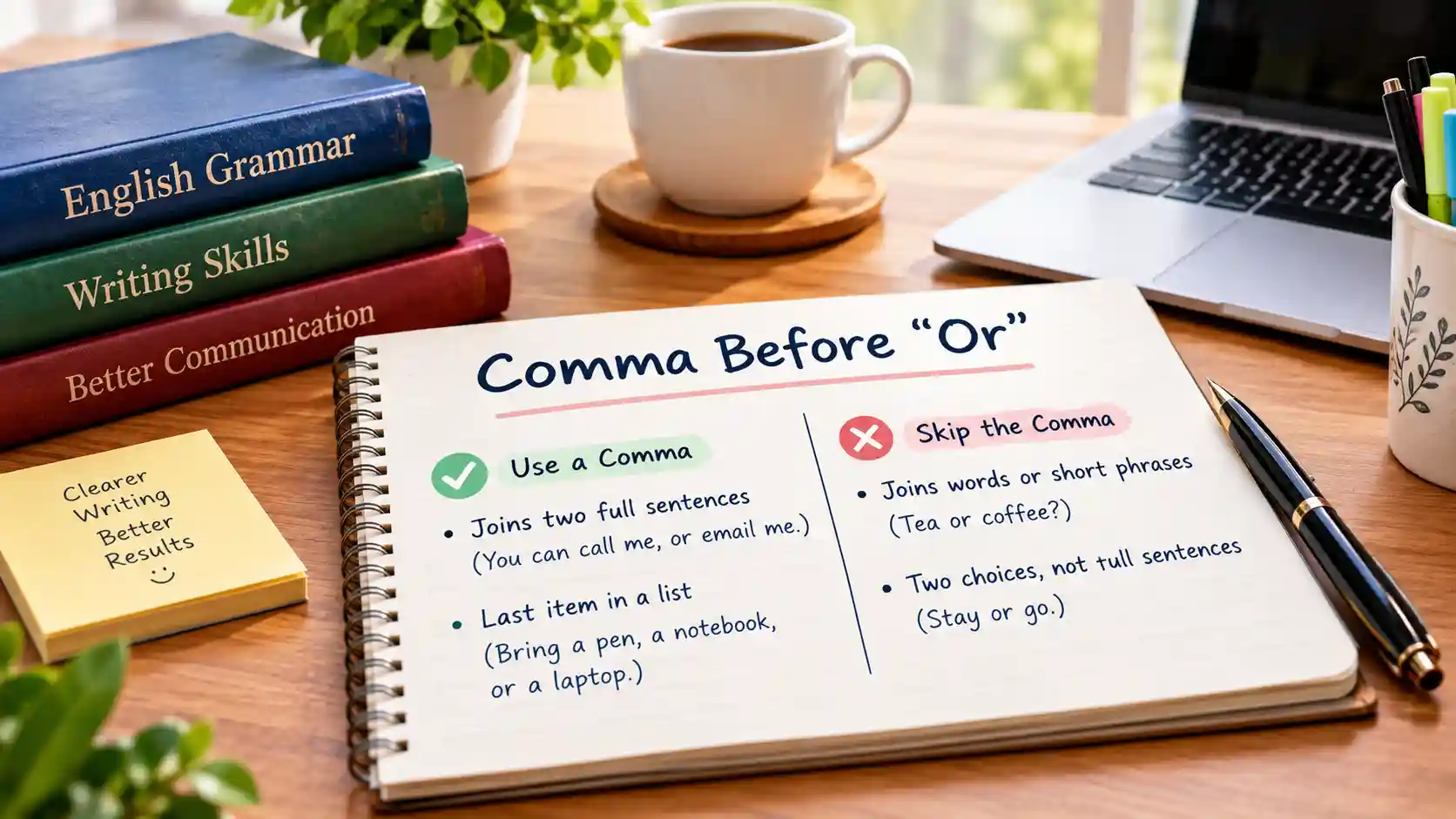
Use a comma before “or” in these cases:
1. When “or” joins two complete sentences (independent clauses).
- “You can call me tonight, or you can email me tomorrow.”
2. When “or” comes before the last item in a list, if you use the serial (Oxford) comma.
- “Bring a pen, a notebook, or a laptop.”
Skip the comma before “or” in these cases:
3. When “or” joins two words or short phrases, not full sentences.
- “Do you want tea or coffee?”
4. When “or” gives just two choices, and each side is not a full sentence.
- “You can stay or go.”
The Origin of the Comma Before “Or”

The comma itself is very old. It comes from the Greek word komma, which meant “a piece cut off” or “a short clause.” Early Greek and Latin writers used small marks to show readers where to pause when reading aloud.
Punctuation rules did not become fixed for a long time. For centuries, writers placed commas by ear, based on breath and rhythm, not on grammar rules. Printers in the 1400s and 1500s started to standardize punctuation, since books needed consistent style.
The rule about commas before words like “and” and “or” grew out of this need for clarity. Grammarians noticed that a comma helps readers see where one full idea ends and another begins. This became the rule for joining two independent clauses with “or,” “and,” “but,” and similar words.
The rule about commas in lists came later. It relates to a printer at Oxford University Press, which is why it is often called the “Oxford comma.” Some publishers used it. Others did not. That split remains today, which is why the list-comma rule still causes confusion.
British English vs American English Style
This is not a spelling difference. It is a style difference. Both American and British English follow the same core grammar rule for joining full sentences with “or.” The real difference shows up in lists.
American English: Many US style guides, like The Chicago Manual of Style and most US book publishers, use the serial comma. This means a comma goes before “or” in a list of three or more items.
British English: Many UK style guides, including most UK newspapers, skip the serial comma. Oxford University Press itself still uses it, which is where the name comes from, but it is not the general UK news style.
| Rule | American Style (common) | British Style (common) |
| Comma before “or” joining two full sentences | Yes | Yes |
| Comma before “or” in a list of three items | Often yes (serial comma) | Often no |
| Example (list) | “Bring a map, a bag, or a torch.” | “Bring a map, a bag or a torch.” |
| Example (full sentences) | “You can walk, or you can drive.” | “You can walk, or you can drive.” |
What to remember: The comma before “or” between two full sentences is the same in both styles. The list comma is where US and UK habits often differ.
Which Style Should You Use?

Writing for a US audience? Use the serial comma. Add a comma before “or” in lists of three or more items. This matches most US book and business writing.
Writing for a UK or Commonwealth audience? You can skip the serial comma in lists, following common newspapers and general UK style. Still, add the comma when “or” joins two full sentences. That rule does not change.
Writing for a global audience, like a website or blog? Either style works. The important thing is to pick one and use it every time on your site.
Following a company or publisher style guide? Always follow that guide first. Many US companies choose the serial comma. Many UK papers do not. If your employer or client has a guide, that decision is already made for you.
Most important: be consistent. Do not use the serial comma in one paragraph and skip it in the next.
Common Mistakes with the Comma Before “Or”
Here are the errors people make most often.
1. Adding a comma when “or” joins only two words.
- Wrong: “Do you want cake, or pie?”
- Right: “Do you want cake or pie?”
2. Leaving out the comma when “or” joins two full sentences.
- Wrong: “You can wait here or I will call you when it is ready.”
- Right: “You can wait here, or I will call you when it is ready.”
3. Mixing serial comma style within one piece of writing.
- Wrong: “Bring a pen, paper, or a bag. Also bring water, snacks and a map.”
- Right (pick one style and keep it): “Bring a pen, paper, or a bag. Also bring water, snacks, and a map.”
4. Using a comma before “or” in a short either/or choice.
- Wrong: “Should I stay, or leave?”
- Right: “Should I stay or leave?”
5. Forgetting the comma in longer list items.
- Wrong: “You may choose a window seat, an aisle seat or extra legroom.”
- Right (with serial comma): “You may choose a window seat, an aisle seat, or extra legroom.”
6. Trusting autocorrect blindly.
Word processors do not always catch this. A missing comma before “or” in a long sentence often slips through spell-check, since it is a grammar issue, not a spelling one.
Comma Before “Or” in Everyday Examples
In emails
- “Let me know if Tuesday works, or suggest another day.”
- “You can reply by email or call the office directly.”
In news writing
- “The mayor said the city could raise taxes, or it could cut services.”
- “Residents were asked to bring a photo ID, a utility bill, or a lease agreement.”
On social media
- “Comment below with your pick: coffee or tea?”
- “Save this post now, or you might forget it later!”
In formal writing
- Report: “The committee can approve the budget, or it can request more information first.”
- Legal text: “The buyer may cancel the agreement, extend the deadline, or renegotiate the price.”
- Academic paper: “Participants could choose task A or task B for the first round.”
Comma Before “Or” Google Trends & Usage Data
I can’t give you exact search numbers here, because they change over time. But the general pattern is easy to see and easy to check.
What the pattern shows:
- People search “comma before or” mostly when writing emails, essays, or work documents. Search interest often rises during the school year and around report-writing seasons at work.
- The related search “Oxford comma” is very popular worldwide, especially in the US, since it often comes up in style debates online.
- English-language writing tools and grammar-checker plugins report that missing or misplaced commas near conjunctions like “or” and “and” are among the most common comma errors.
By country:
- United States: Strong interest in “Oxford comma” and “serial comma,” often tied to the debate over using it or not.
- United Kingdom, Australia, Canada: More general searches about comma rules, often tied to school grammar lessons or writing guides.
How to check the latest data yourself:
- Go to Google Trends.
- Type “comma before or” and compare it with “oxford comma.”
- Set your country and a date range, like the past 12 months.
- Check the “Related queries” box for more specific searches, like “comma before or in a list.”
Why this matters for SEO: many readers search this exact phrase when proofreading their own writing. A clear, simple answer at the top of your article, like the Quick Answer section above, matches what they are looking for right away.
Comma Before “Or” Side-by-Side Comparison
| Situation | Comma Needed? | Example |
| “Or” joins two full sentences | Yes | “You can drive, or you can take the bus.” |
| “Or” joins two short choices (not full sentences) | No | “Do you want soup or salad?” |
| “Or” before the last item in a list (serial comma style) | Yes | “Bring snacks, water, or a snack bar.” |
| “Or” before the last item in a list (non-serial style) | No | “Bring snacks, water or a snack bar.” |
| “Or” in a short either/or question | No | “Coffee or tea?” |
| “Or” starting a new independent clause with a subject and verb | Yes | “Finish the report today, or explain the delay tomorrow.” |
Frequently Asked Questions
Do you always put a comma before “or”?
No. You only need a comma before “or” when it joins two full sentences, or when it comes before the last item in a list if you use the serial comma style.
Is a comma before “or” ever optional?
Yes. In lists, the comma before the final “or” is a style choice. Some guides require it. Others do not.
What is the Oxford comma?
The Oxford comma is the comma placed before the final “and” or “or” in a list of three or more items. Example: “red, white, or blue.”
Is it wrong to skip the comma before “or” in a list?
No. It is not wrong. It depends on your style guide. Just stay consistent within one piece of writing.
Do you need a comma before “or” in a question with two choices?
Usually no, if the choices are short. Example: “Should I call or text?” No comma is needed here.
How do I know if both sides of “or” are full sentences?
Check if each side has its own subject and verb, and could stand alone as a sentence. If yes, add a comma before “or.” If not, skip it.
Does British English use the Oxford comma?
Some British publishers do, including Oxford University Press. But most UK newspapers and general writing tend to skip it in short, simple lists.
Conclusion
So, when do you need a comma before “or”? Now you know the rule is not random. It depends on the job “or” is doing in your sentence.
Here are the key points. Add a comma before “or” when it joins two full sentences, each with its own subject and verb. Add a comma before “or” at the end of a list if you follow the serial (Oxford) comma style. Skip the comma when “or” joins single words or short phrases, or when you use two short choices in a question.
The US versus UK difference is mostly about lists, not about full sentences. Many US writers add the serial comma. Many UK writers skip it in simple lists. Neither choice is wrong. What matters most is staying consistent across your own writing.
Check your sentence structure first. Ask yourself: could both sides of “or” stand alone as full sentences? That one question will answer most of your comma-before-“or” doubts, in emails, reports, and everyday writing.

Haleema Sadia is a passionate content writer specializing in wishes, greetings, messages, and heartfelt quotes. With 3 years of experience, she creates warm, engaging, and SEO-friendly content that helps readers find the perfect words to celebrate special moments and express their feelings.