You just finished a big project. You want to say you feel more pleased than ever before. You start typing “I’ve never been prouder ” then stop. Wait, is that even a word? Should it be “more proud” instead?
This question trips up many careful writers. Most short adjectives just add “-er,” like “faster” or “taller.” But some adjectives feel like they need “more” instead, especially if they seem a bit long or formal. “Proud” sits right in that unsure zone, so people often pause before typing it.
The confusion is not really about spelling. It is about a grammar rule that has some exceptions. Once you know the rule, this word stops being tricky.
In this guide, you will get a quick answer first. Then you will learn where this rule comes from, how American and British English treat it, common mistakes, real examples, usage data, and answers to frequent questions. By the end, you will use “prouder” or “more proud” correctly every time, without guessing.
Prouder or More Proud Quick Answer

Prouder is the correct and standard comparative form of “proud.”
- “I am prouder of you today than I was yesterday.”
- “She felt prouder after finishing the marathon.”
More proud is grammatically understandable, but it is not the standard form. Most style guides and grammar checkers mark it as incorrect or unnecessary.
- Avoid: “I am more proud of you today.”
- Use instead: “I am proud of you today.”
The Origin of “Prouder” and “More Proud”

The confusion comes from a general rule in English grammar about comparative adjectives, not from the history of the word “proud” itself.
The word “proud” comes from Old English prud or prute, which came from Old French meaning “brave” or “excellent.” Over time, in English, the meaning shifted toward today’s sense: feeling pleased and satisfied about something you or someone else has done.
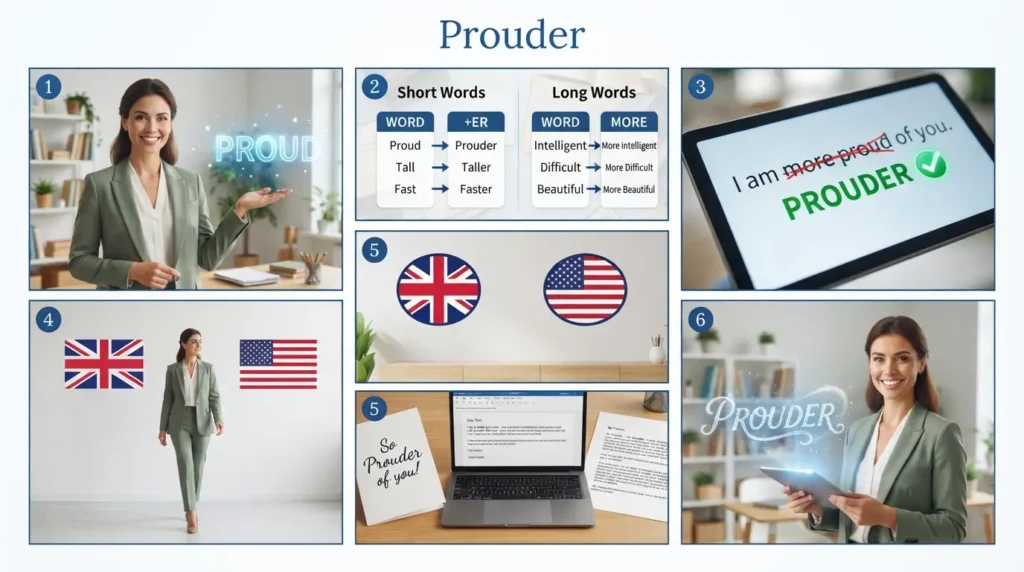
- One-syllable adjectives usually add “-er” for the comparative form. Examples: tall → taller, fast → faster, proud → prouder.
- Adjectives with three or more syllables usually use “more.” Examples: beautiful → more beautiful, important → more important.
- Two-syllable adjectives can go either way, depending on the word’s ending and sound. Examples: happy → happier, but modern → more modern.
“Proud” is a one-syllable word, so it clearly belongs to the “-er” group. But because “more” feels like a safe, formal choice, and because some two- and three-syllable words need “more,” many writers overapply the “more” rule to short words like “proud” as well. That habit is the real root of the confusion, not the word’s history.
British English vs American English Grammar
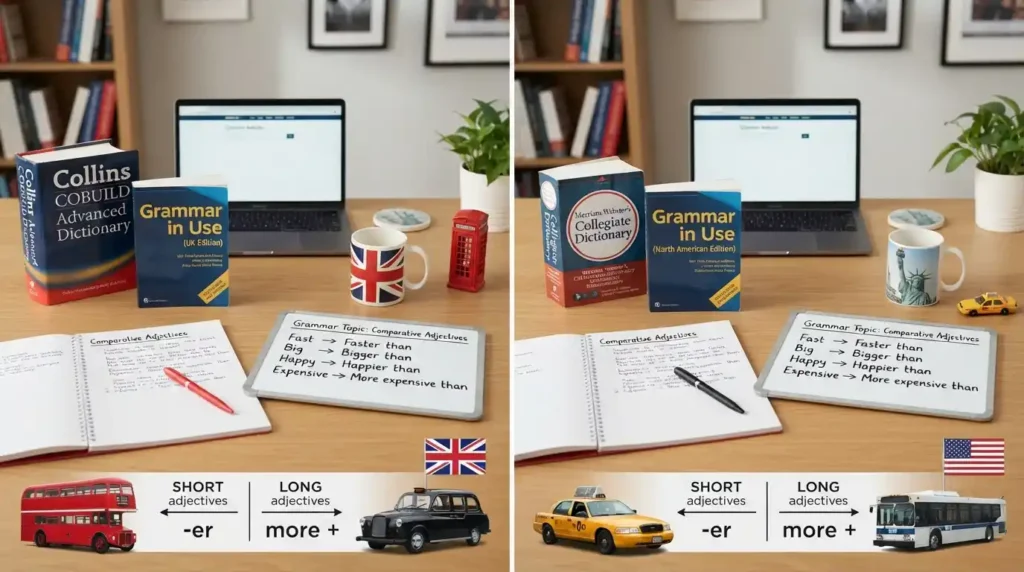
This is not a spelling difference like “color” versus “colour.” Both American English and British English follow the same core comparative rule.
American English: Standard grammar guides, like those used in US schools and style manuals, treat “proud” as a one-syllable adjective. The correct comparative is “prouder.”
British English: The same rule applies. British grammar guides also list “prouder” and “proudest” as the correct forms.
The difference you might notice is more about tone than grammar. In both American and British English, “more proud” can sometimes appear in speech or informal writing, often for emphasis or rhythm, but it is not treated as the standard, correct form in either style.
| Feature | American English | British English |
| Standard comparative | prouder | prouder |
| Standard superlative | proudest | proudest |
| “More proud” accepted in formal writing? | No | No |
| “More proud” heard in casual speech? | Occasionally | Occasionally |
| Grammar rule basis | One-syllable adjectives take “-er” | One-syllable adjectives take “-er” |
What to remember: There is no US versus UK split here. “Prouder” is correct in both. If you write “more proud” for a British or American reader, both may notice it sounds a little off.
Which Form Should You Use?
Since the rule is the same worldwide, your choice depends on formality, not location.
Writing for school, work, or formal documents? Always use “prouder.” This is the standard form taught in grammar books and expected in professional and academic writing.
Writing for a US audience? Use “prouder.” US style guides and grammar checkers will flag “more proud” as non-standard.
Writing for a UK or Commonwealth audience? Use “prouder” as well. The rule does not change across English-speaking countries.
Speaking casually, or writing dialogue in creative writing? “More proud” can appear here for a natural, spoken feel, especially in scripts or fiction where a character speaks informally. This is a stylistic choice, not a grammar rule.
Most important: use “prouder” in any writing meant to look correct and polished. Save “more proud” only for casual speech-like writing, if at all.
Common Mistakes with “Prouder” or “More Proud”
Here are the errors people make most often.
1. Using “more proud” in formal writing.
- Wrong: “The team felt more proud after the win.”
- Right: “The team felt prouder after the win.”
2. Mixing both forms in the same text.
- Wrong: “I am prouder of my daughter than ever, and I feel more proud of my son too.”
- Right: “I am prouder of my daughter than ever, and I feel prouder of my son too.”
3. Using “most proud” instead of “proudest.”
- Wrong: “This is the most proud I have ever felt.”
- Right: “This is the proudest I have ever felt.”
4. Overcorrecting other short adjectives the same way.
- Wrong: “She is more tall than her sister.”
- Right: “She is taller than her sister.”
5. Doubling up the comparative by accident.
- Wrong: “He is prouder than before.”
- Right: “He is prouder than before.”
6. Trusting your ear instead of the rule.
“More proud” can sound fine in casual speech, especially with strong emotion. But grammar checkers and formal readers expect “prouder.” When writing anything official, check the rule instead of relying on how it sounds.
Prouder or More Proud in Everyday Examples
In emails
- “I just wanted to say how much prouder I am of this team after today’s results.”
- “Thank you for your hard work. I could not be prouder of what we built together.”
In news writing
- “Coaches said they had never felt prouder of a team’s effort.”
- “Parents at the ceremony said they felt prouder than ever watching their kids graduate.”
On social media
- “Could not be prouder of my sister today! She did it!”
- “Never felt prouder watching this community come together.”
In formal writing
- Performance review: “The manager reported feeling prouder of the team’s progress this quarter.”
- Academic writing: “Students who received specific feedback reported feeling prouder of their final projects than those who received general praise.”
- Speech: “Today, I stand here prouder than I have ever been to represent this graduating class.”
Prouder or More Proud Google Trends & Usage Data
I can’t give you exact search numbers here, because they change over time. But the general pattern is easy to see and easy to check.
What the pattern shows:
- “Prouder” is used far more often in published writing, news, and formal content than “more proud.”
- Grammar websites and style guides consistently list “prouder” as correct and flag “more proud” as a common error or unnecessary form.
- Search interest for this phrase often rises around graduation season, award ceremonies, and major sports events, when people write about feeling proud of others.
By country:
- United States: Steady interest in comparative adjective rules, often tied to school grammar lessons and writing help searches.
- United Kingdom, Australia, Canada: Similar interest levels, since the rule is shared across English-speaking countries.
- English learners worldwide: This topic is common in ESL grammar guides, since comparative adjective rules are a frequent stumbling block for new English speakers.
How to check the latest data yourself:
- Go to Google Trends.
- Type “prouder” and compare it with “more proud.”
- Set your country and a date range, like the past 12 months.
- Check the “Related queries” box for phrases like “proudest vs most proud.”
Why this matters for SEO: people usually search this phrase while writing something meaningful, like a speech or a heartfelt message. A clear, direct answer at the top of your article, like the Quick Answer section above, matches exactly what they need at that moment.
Prouder vs More Proud Side-by-Side Comparison
| Form | Correct? | Type | Example |
| prouder | Yes (standard) | Comparative | “I am prouder than I was last year.” |
| more proud | No (non-standard) | Comparative | Avoid; use “prouder” instead |
| proudest | Yes (standard) | Superlative | “This is the proudest moment of my life.” |
| most proud | No (non-standard) | Superlative | Avoid; use “proudest” instead |
| proud | — | Base form | “I am proud of you.” |
| prouder than | Yes (standard) | Comparative phrase | “She is prouder than her brother.” |
Frequently Asked Questions
Is it prouder or more proud?
“Prouder” is the correct and standard form. “More proud” is understandable but not considered correct in formal writing.
Is “prouder” a real word?
Yes. “Prouder” is the standard comparative form of “proud,” listed in all major dictionaries.
What is the superlative form of “proud”?
The superlative form is “proudest,” as in “This is the proudest day of my life.”
Why do some adjectives use “more” instead of “-er”?
Longer adjectives, usually with three or more syllables, use “more” instead of adding “-er.” Since “proud” has only one syllable, it follows the “-er” rule instead.
Is “more proud” ever correct?
It is not considered standard grammar, but it can appear in casual speech or informal writing for emphasis. Avoid it in formal or professional writing.
Is this a British versus American English difference?
No. Both British and American English use “prouder” and “proudest” as the standard, correct forms.
Can I use “more proud” in creative writing or dialogue?
Yes, if you want a character to sound casual or if the rhythm of the sentence calls for it. This is a stylistic choice, not a grammar rule, so use it carefully.
Conclusion
So, prouder or more proud? Now you know the answer is not about spelling. It comes down to a simple grammar rule.
Here are the key points. “Proud” is a one-syllable adjective, and most one-syllable adjectives form their comparative by adding “-er.” That makes “prouder” the correct and standard form, with “proudest” as the correct superlative. “More proud” and “most proud” are understandable, but grammar guides and style checkers treat them as non-standard.
This is not a US versus UK issue. Both American and British English follow the same rule and expect “prouder” in formal writing. The only place “more proud” fits naturally is in casual speech or informal dialogue, where rhythm sometimes takes over from strict grammar.
When you are unsure, remember the syllable rule: short words like “proud,” “tall,” and “fast” take “-er.” Save “more” for longer words like “important” or “beautiful.” With that one rule in mind, you will always choose “prouder” with confidence, whether you are writing a speech, an email, or a graduation card.

Zainab Noor is a passionate content writer specializing in grammar and English language topics. With 2 years of experience, she creates clear, engaging, and SEO-friendly content that helps readers understand grammar, improve their writing skills, and use English with greater confidence.