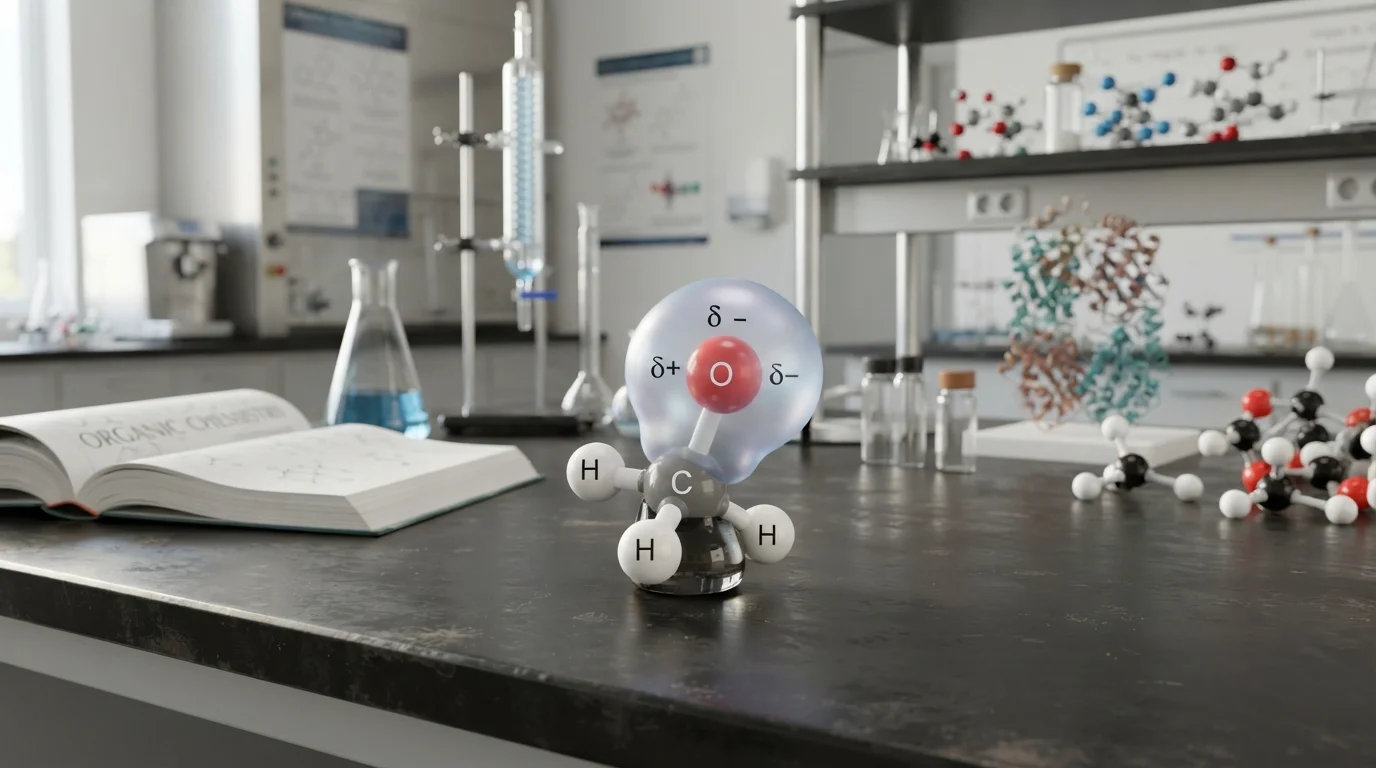
Is CH3OH polar or nonpolar? This is a common chemistry question because methanol has several different bonds and its molecular structure can make polarity seem confusing. CH₃OH, also written as CH₃OH, is the chemical formula for methanol, the simplest alcohol.
The quick answer is that CH₃OH is a polar molecule. Its polarity mainly comes from the oxygen atom and the O–H bond. Oxygen is much more electronegative than carbon and hydrogen, so it pulls shared electrons toward itself. This creates partial charges within the molecule.
However, identifying polarity is not only about looking at individual bonds. You also need to consider the molecule’s overall structure and whether the bond dipoles cancel each other. In methanol, they do not cancel. The molecule therefore has a net dipole moment.
In this guide, you will learn why CH₃OH is polar, how its Lewis structure and shape affect polarity, common mistakes students make, and how methanol compares with other simple molecules.
CH3OH Polar or Nonpolar Quick Answer
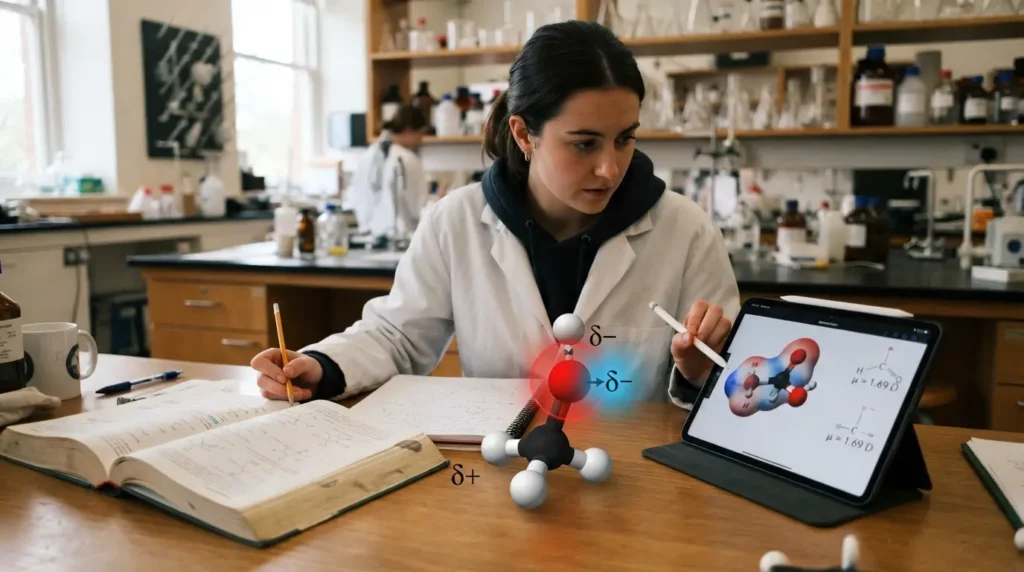
CH₃OH is a polar molecule.
CH₃OH is methanol, an alcohol containing:
- One carbon atom
- Four hydrogen atoms
- One oxygen atom
Its structure can be represented as:
CH₃–OH
The oxygen atom is highly electronegative. It attracts electrons more strongly than carbon and hydrogen. This produces polar bonds, especially the C–O and O–H bonds.
The molecule also has a bent arrangement around the oxygen atom because oxygen has two lone pairs of electrons. As a result, the bond dipoles do not cancel completely.
Therefore:
CH₃OH → Polar
Simple Comparison
- CH₃OH: Polar
- CH₄: Nonpolar
- CO₂: Nonpolar
- H₂O: Polar
The key is to examine both bond polarity and molecular geometry.
The Origin and Structure of CH₃OH
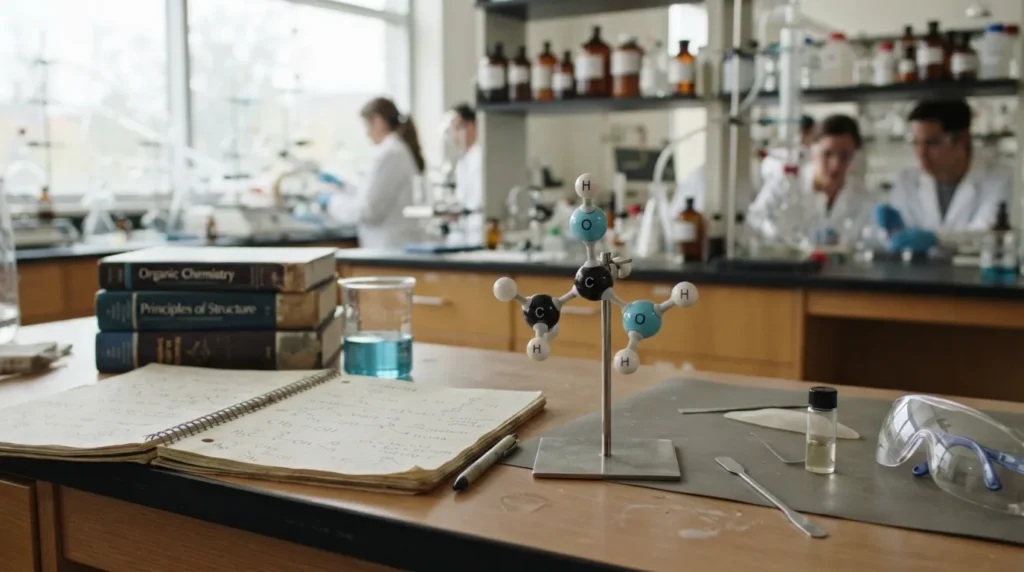
CH₃OH is the molecular formula for methanol, which is the simplest member of the alcohol family.
Methanol contains a methyl group (CH₃–) attached to a hydroxyl group (–OH):
CH₃–OH
The oxygen atom has two bonds and two lone pairs of electrons. This gives the region around oxygen a bent molecular arrangement.
The molecule’s polarity comes from differences in electronegativity. Oxygen attracts bonding electrons more strongly than carbon and hydrogen.
The O–H bond is especially polar because of the large electronegativity difference between oxygen and hydrogen. The C–O bond is also polar.
Because methanol has polar bonds arranged in a way that produces an overall uneven charge distribution, the molecule has a net dipole.
This is why CH₃OH is classified as polar rather than nonpolar.
Molecular Geometry and Polarity of CH₃OH
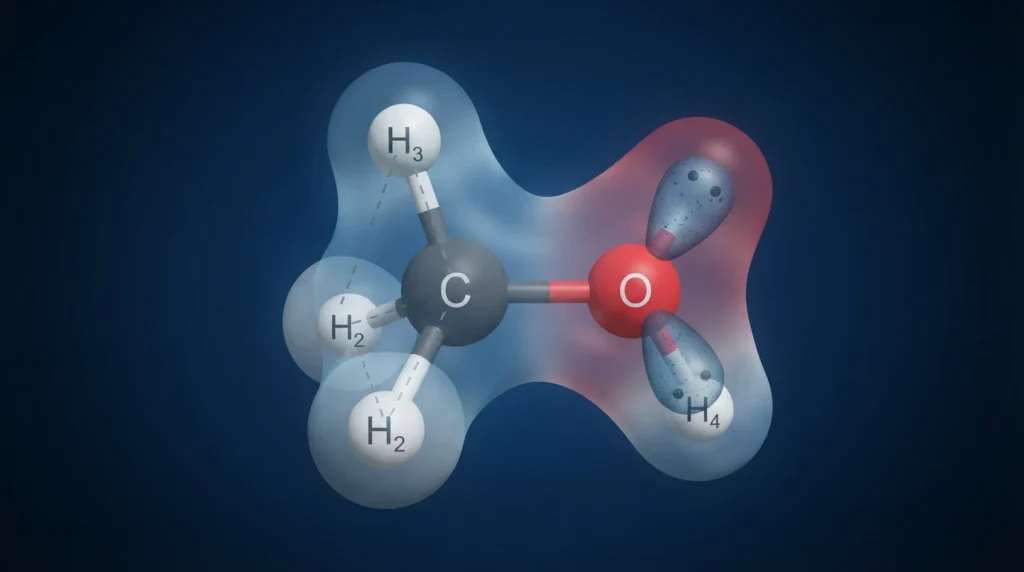
Although the formula is simple, molecular geometry is important when determining polarity.
The carbon atom in the CH₃ group has a roughly tetrahedral arrangement of bonds. The oxygen atom in the hydroxyl group has a bent electron-domain geometry because it has two bonding pairs and two lone pairs.
The molecule is therefore not perfectly symmetrical.
For a molecule to be nonpolar, polar bonds may need to cancel because of molecular symmetry. That does not happen in methanol.
The dipole associated with the C–O and O–H regions contributes to a net molecular dipole.
Key Idea
Polar bonds + an asymmetric molecular arrangement = overall polar molecule.
This is why simply counting atoms is not enough. You need to look at the bonds and three-dimensional structure.
CH3OH Polar or Nonpolar Bond Comparison
| Bond | Polar or Nonpolar? | Reason |
| C–H | Slightly polar | Small electronegativity difference |
| C–O | Polar | Oxygen attracts electrons strongly |
| O–H | Strongly polar | Large electronegativity difference |
| Overall CH₃OH | Polar | Bond dipoles do not cancel |
The C–O and O–H bonds are especially important when explaining methanol’s polarity.
Methanol also has a permanent molecular dipole because its charge distribution is uneven.
Which Explanation Should You Use?
The level of explanation depends on your chemistry course or assignment.
For a Quick Homework Answer
You can write:
CH₃OH is polar because it contains polar C–O and O–H bonds, and its molecular structure gives it a net dipole.
For an Exam
Include both:
- Electronegativity differences
- Molecular geometry
For example:
Methanol is polar because oxygen is more electronegative than carbon and hydrogen, creating polar C–O and O–H bonds. The molecular geometry does not allow these dipoles to cancel completely.
For an Advanced Chemistry Explanation
You can discuss the molecule’s electron density, bond dipoles, lone pairs, and net molecular dipole moment.
The main rule remains the same: CH₃OH has an uneven distribution of electron density, so it is polar.
Common Mistakes with CH3OH Polar or Nonpolar
Mistake 1: Calling CH₃OH Nonpolar Because It Contains Carbon and Hydrogen
Some students focus on the CH₃ group and forget the hydroxyl group.
The presence of oxygen makes a major difference.
Correct: CH₃OH is polar.
Mistake 2: Looking Only at the Number of Atoms
Polarity does not depend simply on how many atoms a molecule contains.
Instead, consider:
- Electronegativity
- Bond polarity
- Molecular geometry
- Symmetry
- Net dipole
Mistake 3: Assuming All C–H Bonds Are Strongly Polar
C–H bonds have only a relatively small electronegativity difference compared with O–H bonds.
The oxygen-containing part of methanol is much more important when explaining its polarity.
Mistake 4: Ignoring Molecular Shape
Even if a molecule has polar bonds, those dipoles can sometimes cancel.
Methanol’s structure does not allow complete cancellation.
CH3OH in Everyday Chemistry Examples
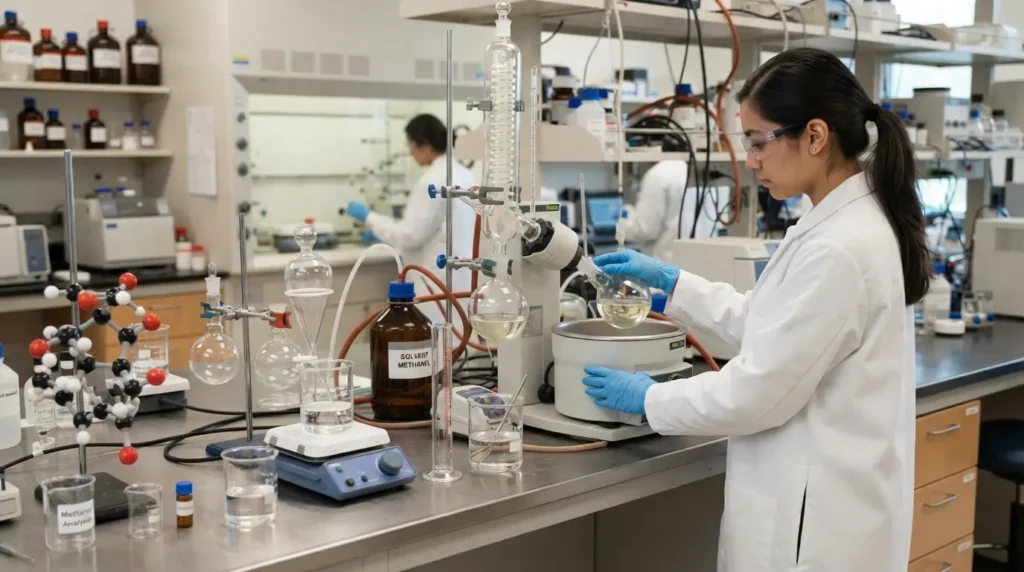
Methanol is a simple alcohol with several important chemical properties. Its polarity helps explain why it interacts with other polar substances.
Because methanol is polar, it can participate in hydrogen bonding through its hydroxyl group. The oxygen atom can accept hydrogen bonds, while the O–H group can donate them.
This helps explain why methanol mixes well with water.
In the Laboratory
Methanol is used as a solvent and chemical reagent in various laboratory processes.
In Chemistry Classes
Students often use methanol as an example when learning about:
- Molecular polarity
- Hydrogen bonding
- Intermolecular forces
- Alcohols
- Solubility
In Everyday Chemical Discussions
When comparing alcohols, methanol can help demonstrate how the hydroxyl group affects molecular behavior.
Its polarity is therefore an important part of understanding its chemistry.
CH3OH Polar or Nonpolar Google Trends & Usage Data
The search phrase “CH3OH polar or nonpolar” is closely connected with chemistry education. Students commonly search for molecular polarity explanations while studying Lewis structures, electronegativity, molecular geometry, and intermolecular forces.
Search interest can vary by country, school schedules, examination periods, and chemistry curricula. Chemistry-related searches may also increase around homework and exam periods.
Google Trends can provide relative search-interest information for a selected country and time period. However, search interest does not directly measure the number of chemistry students or the scientific importance of a topic.
For this question, the scientific answer is stable:
CH₃OH is polar.
The reason is its polar C–O and O–H bonds, combined with an asymmetric molecular structure that produces a net dipole.
CH3OH vs Other Molecules Side-by-Side Comparison
| Molecule | Polar or Nonpolar? | Main Reason |
| CH₃OH | Polar | Polar bonds and uneven charge distribution |
| H₂O | Polar | Bent shape and polar O–H bonds |
| CH₄ | Nonpolar | Symmetrical tetrahedral structure |
| CO₂ | Nonpolar | Linear shape cancels bond dipoles |
| NH₃ | Polar | Trigonal pyramidal shape |
| C₂H₅OH | Polar | Hydroxyl group creates strong polarity |
| CCl₄ | Nonpolar | Symmetrical structure cancels dipoles |
This comparison shows why molecular shape matters. A molecule can contain polar bonds but still be nonpolar if the bond dipoles cancel because of symmetry.
FAQs About CH3OH Polar or Nonpolar
1. Is CH₃OH polar or nonpolar?
CH₃OH is polar. Methanol has polar C–O and O–H bonds and an overall uneven charge distribution.
2. Why is CH₃OH polar?
Methanol is polar because oxygen is more electronegative than carbon and hydrogen. Its polar bonds do not cancel completely.
3. Does CH₃OH have polar bonds?
Yes. The C–O and O–H bonds are polar. The C–H bonds have a much smaller polarity.
4. What is the shape of CH₃OH?
Methanol contains different local geometries. The carbon atom is approximately tetrahedral, while the oxygen atom has a bent arrangement because of its two lone pairs.
5. Can CH₃OH form hydrogen bonds?
Yes. The hydroxyl group allows methanol molecules to participate in hydrogen bonding.
6. Is CH₃OH more polar than CH₄?
Yes. CH₃OH is polar, while CH₄ is nonpolar. The oxygen-containing hydroxyl group gives methanol a significant molecular dipole.
7. Does the shape of CH₃OH affect its polarity?
Yes. The arrangement of its polar bonds and the lone pairs around oxygen prevents complete cancellation of the bond dipoles.
Conclusion
If you are asking “CH3OH polar or nonpolar?”, the answer is clear: CH₃OH is polar. CH₃OH is methanol, a simple alcohol with the structure CH₃–OH.
The main reason for its polarity is the presence of oxygen. Oxygen is more electronegative than both carbon and hydrogen, so the C–O and O–H bonds have uneven electron sharing. The oxygen atom also has two lone pairs, giving the hydroxyl region a bent arrangement.
Most importantly, the bond dipoles do not cancel out. This leaves methanol with a net molecular dipole, making it a polar molecule.
When solving polarity questions, do not look only at the chemical formula. First identify the polar bonds, then examine the molecular geometry and symmetry. This method works for methanol and many other molecules.
A simple rule to remember is: CH₃OH contains a polar hydroxyl group, has an uneven charge distribution, and is therefore polar.

Haleema Sadia is a passionate content writer specializing in wishes, greetings, messages, and heartfelt quotes. With 3 years of experience, she creates warm, engaging, and SEO-friendly content that helps readers find the perfect words to celebrate special moments and express their feelings.