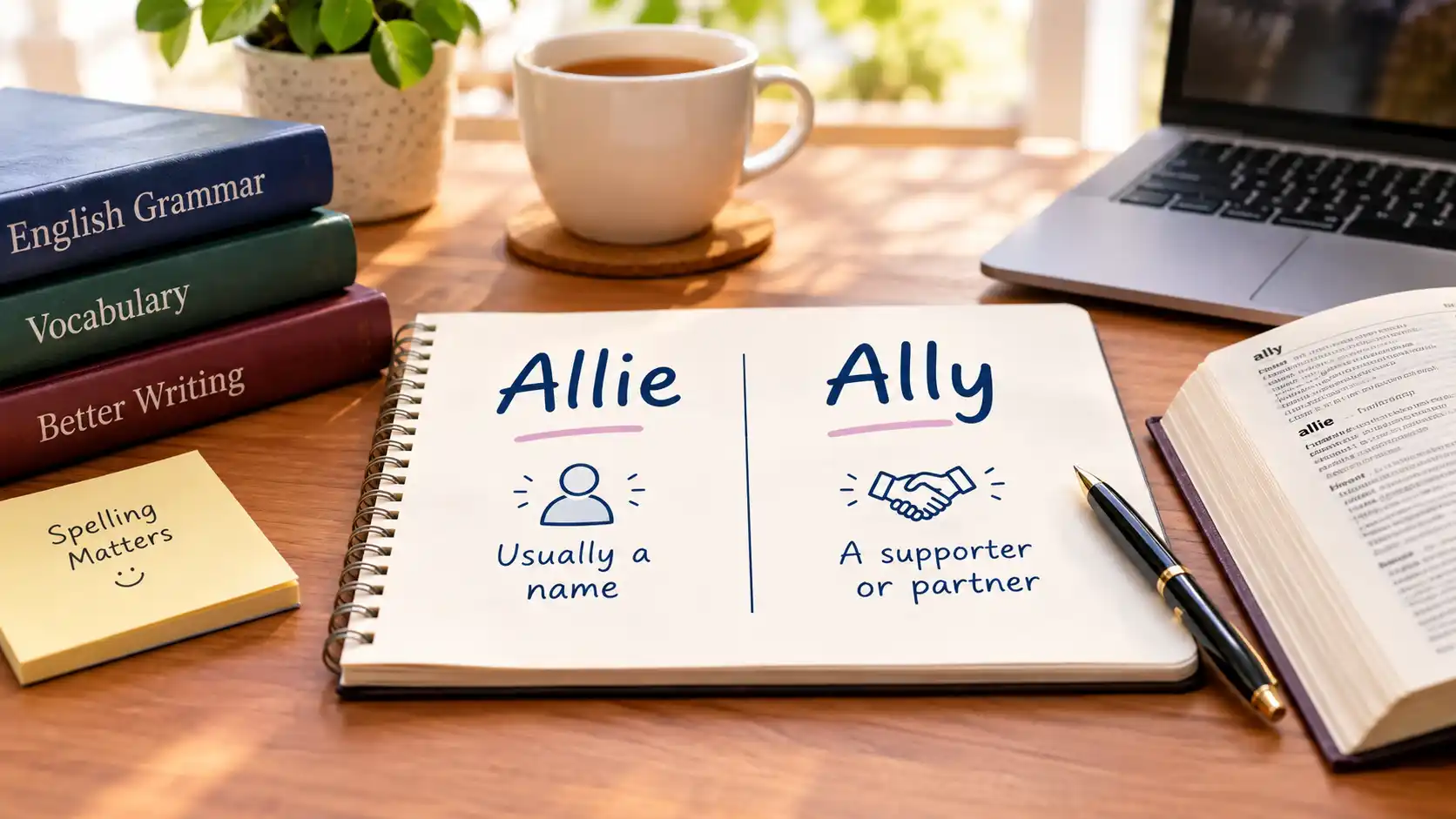
Have you ever typed “Allie or Ally” and stopped because both spellings look right? You are not alone. These two forms are easy to confuse because they look almost the same and can be pronounced similarly, but they do not always serve the same purpose. Ally is a standard English word that means a supporter, partner, or person who works with someone toward a shared goal. Allie, on the other hand, is most often a personal name or nickname. Interestingly, Ally can also be used as a personal name, which makes the distinction even more confusing .
People often search for this spelling pair when writing emails, names, social media posts, school assignments, or professional documents. The good news is that the answer is simple once you know the context. If you mean a supporter or partner, use ally. If you are referring to someone whose name is Allie, use Allie. This guide explains the difference, origin, spelling, common mistakes, and everyday use of both forms.
Allie or Ally Quick Answer

The correct choice depends on what you mean.
- Ally = a supporter, partner, or person who cooperates with someone.
- Allie = usually a personal name or nickname.
- Ally = can also be a personal name or nickname.
For example:
- “She is a strong ally.”
- “The two countries became allies.”
- “Allie sent me an email.”
- “Ally is coming to the meeting.”
The word ally can function as both a noun and a verb. As a noun, it means someone who supports or cooperates with another person or group. As a verb, it means to join or unite with others.
Allie is normally a proper name. Name references list it as a diminutive of names such as Alison and Alexandra.
A simple memory trick is:
Ally = support or partnership
Allie = usually a person’s name
Remember, however, that a person may officially be named Ally, so the person’s chosen spelling always matters.
The Origin of Allie or Ally

The two forms have different histories, even though they look closely related today.
The Origin of Ally
The common English word ally is connected with the idea of joining, supporting, or cooperating with another person or group. It is used in everyday language, business, international relations, history, and many other contexts.
For example:
- “She became an important ally.”
- “The countries remained allies.”
- “The two organizations allied with each other.”
The related noun alliance refers to the relationship or agreement between groups or countries. So, an ally is a person, group, or country involved in that cooperation, while an alliance is the relationship itself.
The Origin of Allie
Allie developed mainly as a short or affectionate form of longer personal names. Name references connect it with names such as Alison and Alexandra, among others beginning with a similar sound.
It is now also used as a standalone given name.
Interestingly, the popularity of the name Allie in the United States increased after the 1984 television series Kate & Allie, according to Behind the Name.
The spelling Ally also became popular as a personal name. Behind the Name notes a rise in the use of Ally as a given name following the 1997 television series .
So, Allie and Ally can both be legitimate names. The spelling should match the person’s actual name.
British English vs American English Spelling
There is no British-versus-American spelling difference between Allie and Ally.
| Form | British English | American English | Main Use |
| ally | ally | ally | Supporter or partner |
| allies | allies | allies | Plural of ally |
| allied | allied | allied | Joined or connected |
| alliance | alliance | alliance | Relationship or agreement |
| Allie | Allie | Allie | Personal name |
| Ally | Ally | Ally | Personal name or nickname |
The important difference is therefore meaning and context, not British or American spelling.
For example, a British writer would say:
“She is a valuable ally.”
An American writer would use the same spelling:
“She is a valuable ally.”
Likewise, if someone’s name is Allie, both British and American writers should spell the name Allie.
Which Spelling Should You Use?
Your choice depends on what you are trying to say.
If You Mean a Supporter, Use “Ally”
Use ally when you mean:
- a supporter
- a partner
- someone who helps you
- a cooperating person or group
- a country working with another country
- someone who supports a cause
Examples:
“She has always been my strongest ally.”
“The company found an ally in its new partner.”
“The countries worked together with their allies.”
If You Mean a Person’s Name, Check the Spelling
If the person’s name is Allie, write:
“Allie will join us later.”
If the person’s name is Ally, write:
“Ally will join us later.”
Do not change someone’s name simply because another spelling looks more familiar.
For US Readers
American English uses both Allie and Ally as names. Neither spelling should automatically be treated as incorrect when it is someone’s actual name.
For UK and Commonwealth Readers
The same basic rule applies. Ally is the normal common English word for a supporter or partner, while Allie may be a personal name.
For Global English
When writing for an international audience, focus on meaning and context. If you are discussing support or cooperation, choose an ally. If you are referring to a specific person, use that person’s official or preferred spelling.
Common Mistakes with Allie or Ally
These words create several common spelling mistakes.
1. Writing “Allie” Instead of “Ally”
Incorrect:
“She is my best allie.”
Correct:
“She is my best ally.”
If you mean a supporter, ally is the correct word.
2. Treating “Allie” as the Standard Word for Supporter
Incorrect:
“Every team needs an allie.”
Correct:
“Every team needs an ally.”
Allie is normally a name, not the standard spelling of the common noun.
3. Changing Someone’s Name
Suppose someone’s name is Allie.
Correct:
“I spoke with Allie yesterday.”
Changing the name to Ally would be incorrect if her actual name is Allie.
4. Forgetting the Capital Letter
When Allie is a person’s name, capitalize it.
Correct:
“Allie sent the report.”
Incorrect:
“Allie sent the report.”
5. Using “Allys” as the Plural
The plural of ally is allies, not allys.
Correct:
“The countries are strong allies.”
6. Confusing “Ally” the Word With “Ally” the Name
Context matters.
“She is an ally.”
Here, ally means a supporter.
“Ally is my colleague.”
Here, Ally is a person’s name.
Allie or Ally in Everyday Examples
Knowing how each form works in real writing makes the difference easier to remember.
In Emails
If you are addressing someone named Allie:
“Hi Allie, I wanted to share the updated document.”
If you are describing a supportive colleague:
“Sarah has been a valuable ally throughout the project.”
In News Writing
Ally is common in news reports about countries, organizations, and partnerships.
“The country called on its allies for additional support.”
“The two nations have remained close allies.”
In Social Media
Both forms can appear online:
“Be an ally to people who need support.”
or:
“Happy birthday, Allie! Hope you have an amazing day!”
The first uses ally as a common noun. The second uses Allie as a name.
In Formal Writing
In academic, business, and professional writing, use ally when referring to support or cooperation.
“The organization became an important ally in the campaign.”
Use Allie only when you are referring to a person with that name.
In History and International Relations
The word ally is especially common when discussing countries that cooperate.
“The nation worked closely with its allies.”
The plural form is allies, not allies with an extra spelling change beyond the standard -y → -ies pattern.
Allie or Ally Google Trends & Usage Data
Search interest for Allie and Ally can come from different types of searches, so raw search popularity should be interpreted carefully.
People searching for Allie are often looking for a person’s name, nickname, spelling, meaning, or name popularity. Ally has a wider range of meanings because it can refer to a supporter, a partner, a country, a social role, or a personal name.
This means search behavior can vary by country and context:
| Search Context | Likely Form | Typical Intent |
| Baby names | Allie / Ally | Name choice or meaning |
| Personal names | Allie / Ally | Correct spelling |
| Friendship and support | ally | Meaning and usage |
| International relations | ally / allies | Countries and cooperation |
| History | ally / Allies | Historical groups or countries |
| Business | ally | Partner or supporter |
| Social media | Allie / Ally | Personal names and captions |
Name popularity also changes over time. Behind the Name records notable popularity increases for Allie and Ally following well-known American television shows in different periods.
Because Google Trends reports relative search interest, rather than a universal count of correct spellings, it is better to use it to understand search behavior than to decide whether one spelling is linguistically correct.
What Searchers Usually Want to Know
The most common intent behind searches for “Allie or Ally” is usually one of these questions:
- Which spelling is correct?
- Is Allie a name?
- Is Ally a name?
- How do you spell ally?
- Is “allie” a word?
- What is the plural of ally?
- Should a person’s name be Allie or Ally?
The answer depends on context rather than British or American spelling.
Allie vs Ally Comparison Table
| Feature | Allie | Ally |
| Main role | Personal name | Common word |
| Can it be a name? | Yes | Yes |
| Means supporter? | No, normally | Yes |
| Can it be a verb? | No | Yes |
| Capitalized? | Yes when a name | No unless a name or sentence beginning |
| Plural | Depends on the name | Allies |
| Example | “Allie called me.” | “She is my ally.” |
| Common context | Names and nicknames | Support, cooperation, partnerships |
The key point is simple: Allie and Ally are not interchangeable when one is a name and the other is a common English word.
FAQs About Allie or Ally
1. Is Allie or Ally correct?
Both can be correct, but they are used differently. Ally is the standard English word for a supporter or partner. Allie is usually a personal name or nickname.
2. Is “Allie” a real name?
Yes. Allie is an established English given name and nickname. It is associated with names such as Alison and Alexandra.
3. Can Ally be a person’s name?
Yes. Ally can also be used as a personal name or nickname.
4. Is “allie” a word?
As a standard common English word meaning a supporter, allie is not the correct spelling. Use ally. However, Allie is a valid personal name.
5. What is the plural of ally?
The plural is allies.
Example:
“The two countries became allies.”
6. How do I remember Allie vs Ally?
Think of the meaning:
Ally = supporter or partner.
Allie = usually a person’s name.
7. Is there a British spelling of ally?
No. Ally is spelled the same in British and American English. The difference is not regional spelling but meaning and context.
Conclusion:
The difference between Allie or Ally becomes easy once you focus on meaning. Ally is the standard English word for a supporter, partner, or person, group, or country that cooperates with another. It can also function as a verb, as in “the organizations allied together.” Its plural form is allies, while related words include alliance and allied.
Allie, meanwhile, is usually a personal name or nickname. It can be used for someone named Allie, and Ally can also be a personal name. Because names belong to the people who use them, always check the person’s preferred or official spelling.
There is no special British-versus-American spelling rule that changes Allie or ally. The real difference is context. When you mean support or partnership, choose an ally. When you mean someone’s name, use the exact spelling of that person’s name. Once you remember this simple rule, you can avoid the most common mistakes in emails, essays, news writing, social media, and everyday English.

Zainab Noor is a passionate content writer specializing in grammar and English language topics. With 2 years of experience, she creates clear, engaging, and SEO-friendly content that helps readers understand grammar, improve their writing skills, and use English with greater confidence.