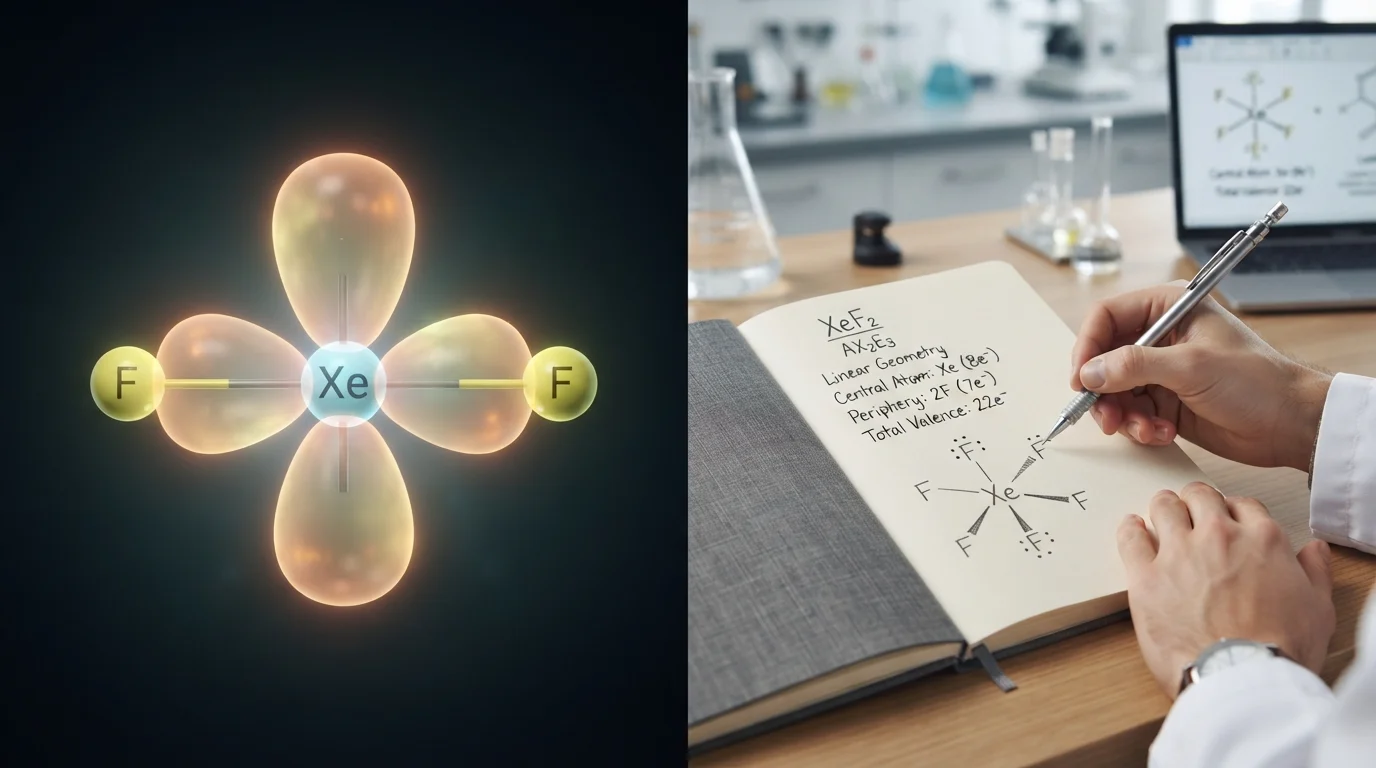
You’re working through a chemistry assignment on noble gas compounds, and you hit a strange one: XeF2, xenon difluoride. Wait, xenon forms bonds? Isn’t it a noble gas that’s supposed to be unreactive? And once you get past that surprise, the next question hits: is XeF2 polar or nonpolar?
This is one of the more advanced polarity questions students encounter, mainly because XeF2 involves concepts many haven’t fully mastered yet: lone pairs on the central atom and how they affect molecular shape. People search for this while studying VSEPR theory, preparing for AP Chemistry exams, or working through advanced inorganic chemistry coursework.
The confusion usually comes from not accounting for xenon’s lone pairs when determining the molecule’s shape. Many students assume any molecule with polar bonds must automatically be polar overall, without checking how the atoms are actually arranged in three-dimensional space.
This article gives you the quick answer, explains the science behind it, shows you how to verify it yourself, and addresses the specific mistakes students make with this trickier example. By the end, you’ll fully understand not just the answer, but why it works this way.
XeF2 Polar or Nonpolar Quick Answer
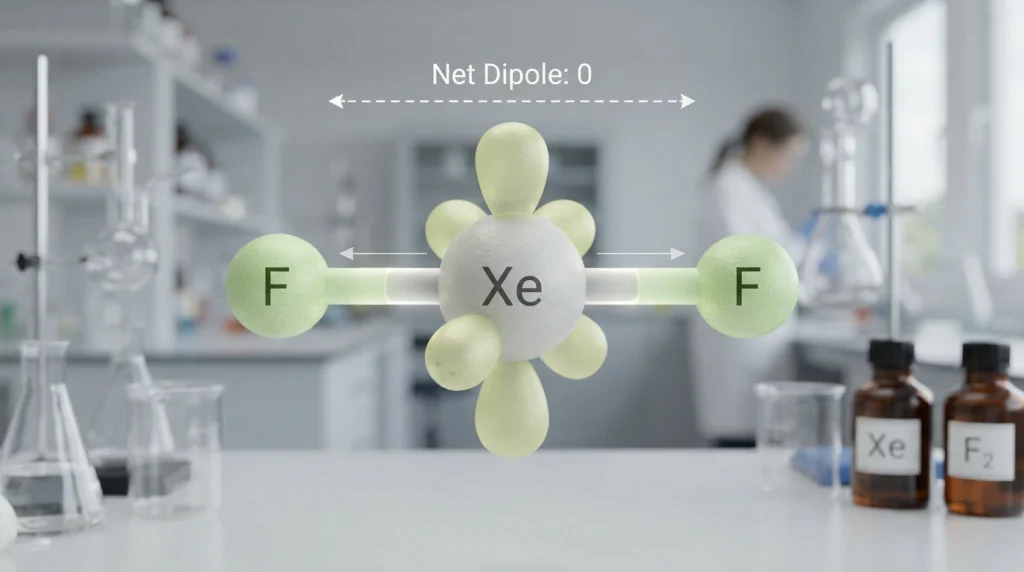
XeF2 is nonpolar.
Here’s why in one sentence: XeF2 has a linear molecular shape, so the two polar Xe-F bonds point in exactly opposite directions and cancel each other out completely, leaving no net dipole moment.
Quick comparison:
- Bonds inside XeF2: Polar (xenon and fluorine have different electronegativities)
- Overall molecule: Nonpolar (linear shape causes the bond polarities to cancel)
XeF2 is a great example of how lone pairs on a central atom can still result in a nonpolar molecule, as long as the overall shape stays symmetrical.
The Science Behind XeF2’s Polarity
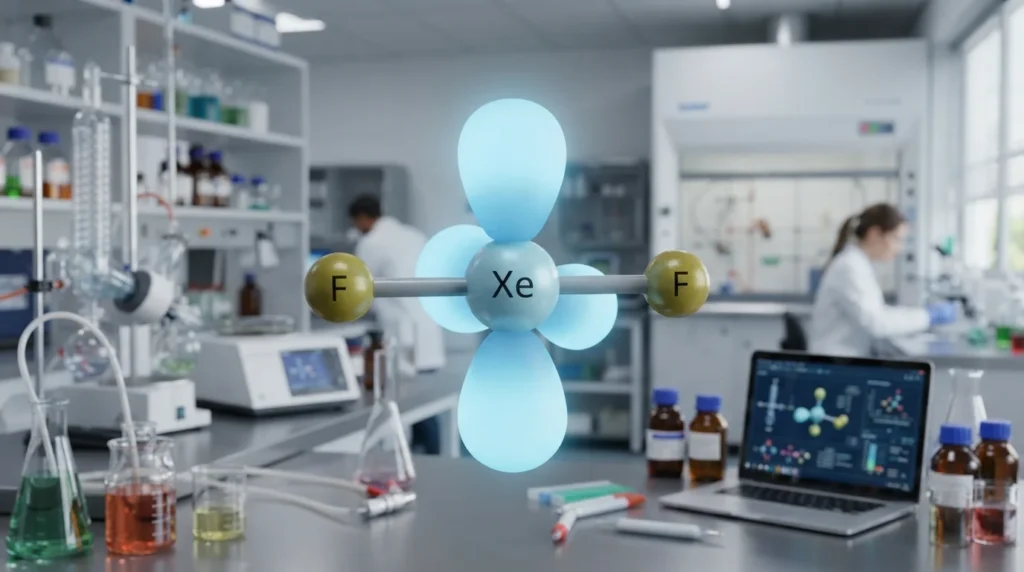
To understand why XeF2 is nonpolar, you need to look at electronegativity, lone pairs, and molecular geometry together.
Electronegativity determines how strongly an atom pulls shared electrons. Fluorine is highly electronegative, while xenon, despite being a noble gas, can still form bonds under the right conditions and has lower electronegativity than fluorine. This creates a polar bond in each Xe-F connection.
Lone pairs matter here because xenon in XeF2 has three lone pairs of electrons in addition to its two bonds to fluorine. These lone pairs, combined with the two bonding pairs, give xenon five total electron groups, which arrange themselves into a trigonal bipyramidal electron geometry to minimize repulsion.
However, the three lone pairs position themselves in the equatorial positions of that trigonal bipyramidal arrangement, pushing the two fluorine atoms into a straight line on opposite sides of the xenon atom. This results in a linear molecular shape, even though the underlying electron geometry is more complex.
Because the two Xe-F bonds point in exactly opposite directions, 180 degrees apart, their individual polar pulls cancel each other out perfectly, just like two people pulling equally hard on a rope from opposite ends. The result: no net dipole moment, and therefore, a nonpolar molecule overall.
Polar Bonds vs Nonpolar Molecules: How to Tell the Difference
XeF2 is a great case study for understanding how lone pairs influence shape and polarity.
| Factor | What to Check | XeF2 Example |
| Bond polarity | Difference in electronegativity between atoms | Xe-F bonds are polar |
| Lone pairs on central atom | How many, and how do they affect shape? | 3 lone pairs on xenon |
| Electron geometry | Arrangement of all electron groups | Trigonal bipyramidal |
| Molecular shape | Arrangement of only the atoms (ignoring lone pairs) | Linear |
| Net dipole moment | Do the bond pulls cancel out? | Yes, in XeF2 |
| Final classification | Polar or nonpolar molecule | Nonpolar |
The key takeaway: electron geometry and molecular shape are not always the same thing. Lone pairs count toward electron geometry but aren’t visible in the final molecular shape, and that shape is what actually determines polarity.
How to Determine Polarity Yourself (Step-by-Step Method)

- For students: Start by drawing the Lewis structure and counting all electron groups (bonds and lone pairs) around the central atom. Use VSEPR theory to determine the electron geometry, then figure out the molecular shape by considering only the positions of the atoms, not the lone pairs.
- For exam prep: Memorize that linear shapes (whether from no lone pairs, like CO2, or from three lone pairs positioned equatorially, like XeF2) result in nonpolar molecules when both outer atoms are identical.
- For general understanding: Remember that lone pairs don’t disappear, they still take up space and influence shape, but they aren’t counted as separate “arms” in the final molecular shape used for polarity decisions.
Common Mistakes with XeF2 Polarity

- Forgetting to account for lone pairs on xenon : Some students only count the two Xe-F bonds and miss the three lone pairs that actually shape the molecule.
- Confusing electron geometry with molecular shape : XeF2’s electron geometry is trigonal bipyramidal, but its molecular shape (the one that matters for polarity) is linear.
- Assuming polar bonds always create a polar molecule : Just like with CF4, having polar Xe-F bonds doesn’t automatically make XeF2 a polar molecule.
- Underestimating xenon’s ability to bond : Some students mistakenly think noble gases like xenon can never form compounds, when in fact certain heavier noble gases do react under specific conditions.
- Mixing up XeF2 with other xenon fluorides : Compounds like XeF4 (which is also nonpolar, but square planar) have different shapes and require separate analysis.
XeF2 Polarity in Everyday Examples
In a chemistry email to a professor:
“I understand that XeF₂ is nonpolar because its linear molecular geometry causes the polar Xe–F bond dipoles to cancel each other out.”
science news:
“Xenon difluoride (XeF₂) is one of the few stable noble gas compounds and has practical applications in semiconductor etching.”
In a student study group chat:
“XeF₂ is linear because the three lone pairs on the xenon atom arrange themselves around the central atom, creating a symmetrical shape. As a result, the polar Xe–F bond dipoles cancel out, making XeF₂ nonpolar overall.”
In formal academic writing: “XeF2 demonstrates nonpolar character despite the presence of polar Xe-F bonds, a result of its linear molecular geometry arising from three equatorial lone pairs on the central xenon atom.”
XeF2 Polar or Nonpolar Google Trends & Usage Data
Search interest in “XeF2 polar or nonpolar” appears most frequently during advanced high school and early college chemistry courses, particularly when students study noble gas compounds and more complex VSEPR theory applications. The United States shows strong search volume tied to AP Chemistry and general chemistry curricula, with additional interest from students in India and other countries with rigorous chemistry education systems.
This keyword often appears alongside related searches like “XeF2 molecular geometry,” “XeF2 lone pairs,” and “XeF2 hybridization,” as students typically research the full structural picture rather than just the polarity answer alone. XeF2 also draws interest from materials science and semiconductor industry contexts, given its real-world application in microchip manufacturing.
Keyword Variation Comparison Table
| Variation | Common Use | Search Context |
| XeF2 polar or nonpolar | Most common search phrase | Homework, exam prep |
| Is XeF2 polar | Direct question format | Quick fact-checking |
| XeF2 molecular geometry | Structural analysis question | Deeper study, shape determination |
| XeF2 lone pairs | Electron arrangement question | VSEPR theory practice |
| Xenon difluoride polarity | Formal/scientific naming | Academic papers, formal study |
FAQs
1. Is XeF2 polar or nonpolar?
XeF2 is nonpolar. Its linear molecular shape causes the two polar Xe-F bonds to cancel each other out completely.
2. Are the bonds in XeF2 polar or nonpolar?
The individual Xe-F bonds are polar because fluorine is more electronegative than xenon.
3. Why is XeF2 nonpolar if its bonds are polar?
Because XeF2 has a linear molecular shape, the two Xe-F bond pulls point in exactly opposite directions and cancel out, leaving no net dipole moment.
4. What is the molecular shape of XeF2?
XeF2 has a linear molecular shape, even though its electron geometry (including lone pairs) is trigonal bipyramidal.
5. How many lone pairs does xenon have in XeF2?
Xenon has three lone pairs in XeF2, positioned in the equatorial spots of a trigonal bipyramidal electron arrangement.
6. Can xenon really form chemical bonds?
Yes. While xenon is a noble gas and generally unreactive, it can form stable compounds like XeF2 under specific laboratory conditions.
7. Is XeF2 similar to CO2 in terms of shape and polarity?
Yes, both are linear and nonpolar, though CO2 has no lone pairs on its central carbon atom, while XeF2’s linear shape comes from three lone pairs pushing the fluorine atoms into a straight line.
Conclusion
XeF2 is nonpolar, even though its individual xenon-fluorine bonds are polar. The key reason is its linear molecular shape, caused by three lone pairs on the xenon atom positioning themselves equatorially, which pushes the two fluorine atoms into a perfectly straight line on opposite sides of xenon.
This is a great example of how lone pairs, while not visible in a molecule’s final shape, still play a critical role in determining that shape, and ultimately, the molecule’s overall polarity. Understanding the difference between electron geometry and molecular shape is the key skill needed to solve problems like this one confidently.
Whether you’re studying advanced VSEPR theory, preparing for an exam, or just curious about noble gas chemistry, remember the two-step check: identify the bond polarity, then carefully determine the molecular shape, accounting for all lone pairs. If the shape is symmetrical, like XeF2’s linear structure, the molecule is nonpolar overall.

Zainab Noor is a passionate content writer specializing in grammar and English language topics. With 2 years of experience, she creates clear, engaging, and SEO-friendly content that helps readers understand grammar, improve their writing skills, and use English with greater confidence.