
When you write about fighting fraud, reducing pollution, or tackling climate change, you may hesitate over the spelling combatting or combating. Both forms appear in English writing, so it is understandable to wonder whether one is incorrect or whether the difference comes from American and British English.
The good news is that both “combating” and “combatting” are accepted spellings of the present participle of combat. However, their usage can vary by region, publication, and writing style. Understanding this difference can help you choose the form that best suits your audience.
In this guide, we will explore combatting or combating, explain why both spellings exist, compare their use in American and British English, and examine common mistakes. You will also find practical examples, a comparison table, and answers to frequently asked questions. By the end, you will know how to use both forms confidently in everyday and professional writing.
Combatting or Combating Quick Answer
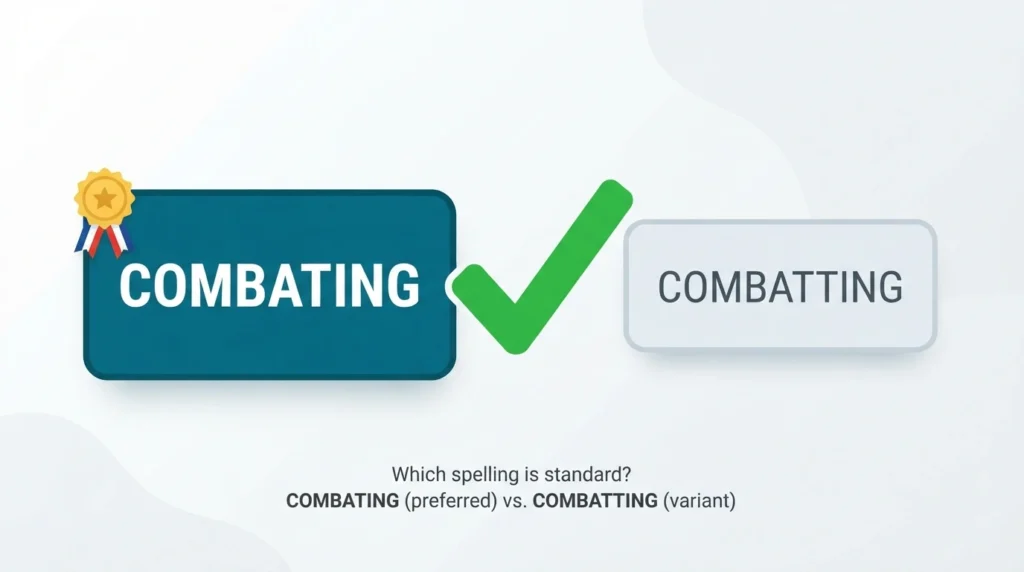
Combating is the standard spelling. Most dictionaries list it first. It is the best choice for almost every reader.
Combatting is a less common variant. It is not a mistake. Some writers and style guides use it.
Both words mean the same thing: to fight against something or try to stop it.
Examples:
- “The city is combating air pollution.”
- “The city is combatting air pollution.” (accepted, but less common)
- “The team combated the fire for hours.”
- “The team combated the fire for hours.” (accepted, but less common)
Short rule: Use combating. Use combat only if your style guide says so.
This is not a clean US versus UK split. You will see both spellings in both places. But combating leads in both.
The Origin of Combatting or Combating

The word is old. It comes from the Latin word com battere. It has two parts:
- com means “with” or “together”
- battuere means “to beat” or “to strike”
So the word first meant “to beat with someone,” or to fight.
Old French took the word as combattre. English borrowed it in the 1500s. At first it was a noun and a verb about fighting in battle. Over time, the verb also came to mean fighting a problem, like crime or disease.
So why two spellings? It comes down to sound.
English has a spelling rule. If the stress falls on the last syllable of a verb, you double the last consonant before -ing or -ed. Think of beginning and beginning. Or commit and commit.
Now say the verb combat. Some people say COM-bat. Others say com-BAT. When the stress is on the first part, you write one T. When the stress is on the last part, you may write two.
Both stress patterns exist. That is why both spellings exist. The meaning never changed.
Why Are Combatting and Combating Both Used?
The difference between combatting or combating comes from the way English spelling has developed over time. Both forms are connected to the verb combat, which means to fight against something, oppose a problem, or work to stop an unwanted situation.
The word combat entered English through French and ultimately traces back to Latin. Over time, English speakers developed different spelling preferences for adding the suffix -ing.
Some writers use combating, while others prefer combatting. Both forms have become established in dictionaries and published writing.
For example:
- The government is combating financial fraud.
- The government is combatting financial fraud.
- Researchers are combating antibiotic resistance.
- Researchers are combatting antibiotic resistance.
The meaning remains the same in each example. The spelling changes, but the action does not.
Why Does the T Sometimes Double?
English has several spelling patterns involving doubled consonants. For example:
- Run → running
- Stop → stopping
- Plan → planning
However, the spelling of combat does not follow a simple rule that makes one form correct and the other incorrect. Both combating and combatting are established spellings.
Therefore, you should not assume that the single-T form is always American or that the double-T form is always British. Regional preferences exist, but they are not absolute.
Combatting or Combating in American and British English
Many English spelling differences are strongly associated with particular regions. For example, American English commonly uses color, while British English generally uses colour. The situation is less straightforward with combatting or combating.
Both forms appear in American and British writing. However, combatting is particularly associated with British usage, while combating is widely used in international English.
Here is a general comparison: case.
| Word | American English | British English | Same in both? |
| combat | combating (common), combatting (less common) | combating (common), combatting (less common) | Mostly yes |
| format | formatting | formatting | Yes |
| target | targeting | targeting | Yes |
| travel | traveling | travelling | No |
| worship | worshiped | worshipped | No |
What to remember: For combat, the leading spelling is the same on both sides of the Atlantic. It is combating.
Which Spelling Should You Use?
Pick the spelling that fits your reader. The good news is that the choice is easy.
Writing for an American audience?
Use combating. It is the main form in US dictionaries and news writing.
Writing for the UK or Commonwealth?
Use combating as your default. This covers Britain, Australia, New Zealand, Ireland, India, and South Africa. You may see combat in some UK writing, but it is still the smaller choice.
Writing for a global audience?
Use combating. It is the least likely to make any reader stop and wonder.
Following a style guide?
Do what the guide says. Some brands and papers pick combatting on purpose. If yours does, use it every time.
Most important: be consistent. Do not use both spellings in one article. Do not switch halfway through a report.
Common Mistakes With Combatting or Combating
- The organization is combating poverty.
- The government is combating Writers often become confused when they encounter both forms. Here are some common mistakes to avoid.
1. Assuming One Spelling Is Always Wrong
Some people believe that combatting is incorrect because it contains two T’s. Others assume that combating is wrong because the consonant is not doubled.
Both assumptions are incorrect. Both spellings are accepted.
Correct examples:
- The team is combating fraud.
- The team is combatting fraud.
2. Mixing Both Spellings Without a Reason
Using both forms in the same article can make your writing look inconsistent.
Inconsistent:
The organization is combating fraud and combatting online scams.
Consistent:
The organization is combating fraud and combating online scams.
Alternatively:
The organization is combatting fraud and combatting online scams.
Either version is grammatically acceptable.
3. Confusing Combat With Combatting
The words combat and combatting have different grammatical roles.
- Combat: The base form of the verb.
- Combating: The present participle or gerund.
- Combatting: An alternative present participle or gerund.
- Combated: A past-tense and past-participle form.
- Combatted: An alternative past-tense and past-participle form.
Examples:
- We must combat misinformation.
- We are combating misinformation.
- We are combatting misinformation.
- The organization combated the problem last year.
- The organization combatted the problem last year.
4. Confusing Combatting With Combatant
These words look similar but have different meanings.
| Word | Meaning | Example |
| Combat | To fight against something | We must combat fraud. |
| Combating | Fighting against something | The team is combating fraud. |
| Combatting | An alternative spelling of combating | The team is combatting fraud. |
| Combatant | A person or group involved in fighting | The combatant left the field. |
| Combative | Ready or inclined to argue or fight | He adopted a combative tone. |
Remember that combatant refers to a participant in a conflict, while combating and combatting describe the action of fighting against something.
5. Using Combat When Another Verb Fits Better
Although combat means to fight against or try to stop something, it is not the best verb for every situation.
For example:
Less natural:
The firefighters combated the fire for hours.
More natural:
The firefighters battled the fire for hours.
However, combat works naturally when discussing problems such as fraud, disease, crime, and misinformation.
Examples:
- The company is combating fraud.
- Researchers are combating disease.
- cybercrime.
6. Relying on Spell-Check Alone
Some spelling tools may recognize both forms. Therefore, a spell-checker may not tell you which version best suits your audience or publication.
When writing professionally, check your organization’s style guide and review your document for consistency.
Here are the errors people make most often.
1. Thinking one spelling is wrong.
Neither is wrong. One is just more common.
2. Mixing both spellings in one text.
- Wrong: “We are combating fraud and combatting spam.”
- Right: “We are combating fraud and combating spam.”
3. Mixing the tense forms.
- Wrong: “We combated fraud and are now combatting spam.”
- Right: “We combated fraud and are now combating spam.”
- Also right: “We combatted fraud and are now combating spam.”
The pairs go together. Combated goes with combating. Combat goes with combatting.
4. Doubling the T in related words.
- Wrong: combattant, combattive
- Right: combatant, combative
5. Typing the wrong letters.
| Wrong | Right |
| combating | combating |
| combating | combating |
| combating | combating |
| combatting | combatting |
6. Adding “against” when you do not need it.
- Wordy: “We must combat crime.”
- Better: “We must combat crime.”
Combat already means to fight against something. So the shorter form is cleaner.
7. Trusting your spell-checker blindly.
Most spell-checkers accept both spellings. So they will not warn you if you mix them. You have to check for this yourself.
Combatting or Combating in Everyday Examples
In emails
- “Hi Dana, our new tool helps with combating late payments. Let me know if you want a demo.”
- “Thank you for joining the group. We are focused on combating waste across all our offices.”
In news writing
- “The government announced a new plan for combating food shortages.”
- “Local groups are combating rising heat with more shade and trees.”
On social media
- “Small steps matter when it comes to combating climate change. #EarthDay”
- “Combating burnout starts with real rest. Take your break today.”
In formal writing
- Report: “This study looks at methods for combating misinformation online.”
- Policy paper: “The agency has expanded its role in combating financial fraud.”
- Academic paper: “Strategies for combating antibiotic resistance are described in Section 3.”
In all these examples, combating fits well. If your style guide picks combatting, swap it in everywhere.
Combatting or Combating Google Trends & Usage Data
I can’t give you exact search numbers here, because they change over time. But the general pattern is easy to see and easy to check.
What the pattern shows:
- Combating is used far more than combatting in published writing.
- Major dictionaries list combating first. They list combatting as a variant.
- Both spellings appear in the US, the UK, and other English-speaking countries. There is no strong national split.
By context:
- Combating is common in news headlines, policy papers, and reports. Think of phrases like “combating fraud” or “combating climate change.”
- Combatting shows up less often. You may still see it in blogs, older texts, and writing that follows a certain house style.
How to check the latest data yourself:
- Go to Google Trends.
- Type “combating” and add “combatting” to compare.
- Pick the country you care about.
- Set a date range, like the past five years.
- You can also try Google Books Ngram Viewer for long-term history.
Why this matters for SEO: Google treats both spellings as close matches. Still, people type combating more often. So use combating in your title and headings. You can use combatting once or twice in the text to catch those searches.
Combatting vs Combating Side-by-Side Comparison
| Variation | Type | How Common | Example |
| combat | Noun / base verb | Very common | “We combat spam daily.” |
| combats | Present tense | Common | “She combats stress with yoga.” |
| combated | Past tense | Common | “They combated the problem early.” |
| combatted | Past tense (variant) | Less common | “They combatted the problem early.” |
| combating | Ongoing verb | Very common | “We are combating hunger.” |
| combatting | Ongoing verb (variant) | Less common | “We are combatting hunger.” |
| combatant | Noun | Common | “Each combatant wore a helmet.” |
| combative | Adjective | Common | “He had a combative tone.” |
Frequently Asked Questions
Is it combatting or combating?
Both are accepted. But combating is far more common and is the safer choice.
Is combatting wrong?
No. It is a valid variant. Some dictionaries list it. It is just less common than combating.
Is it American or British?
Neither. It is the leading spelling in both the US and the UK. Other English-speaking countries use it too.
What is the past tense: combated or combatted?
Both are accepted. Combating is more common. Match the pair: combated with combating, and combatted with combatting.
Why do some people double the T?
It comes from a spelling rule. When the stress is on the last syllable, you often double the final consonant. Some people say com-BAT, so they write two Ts.
Do combatant and combative have one T or two?
One T. Write combatant and combative.
Which spelling is better for SEO?
Use combating in your title and main headings, since more people type it. You can mention combatting once or twice in the body if you want to match both searches.
Can I use both spellings in one article?
Only if the article is about the spelling difference, like this one. In all other writing, pick one and keep it.
Conclusion
So, combatting or combating? Now you know. Both are accepted. But combating is the better choice for almost every writer.
Here are the key points. Combat comes from Old French and Latin. It means to fight or to beat. The verb can be said two ways: COM-bat or com-BAT. That is why some writers double the T. Most dictionaries list combating first. They list combatting as a variant. This is not a US versus UK split. Both spellings appear in both places, but combating leads in both.
Your choice is easy.Use combating for US, UK, Commonwealth, and global audiences. Choose combatting only when a specific style guide, publication, or client requires it.
Avoid these traps. Do not mix both spellings in one text. Match the past tense: combated goes with combating, and combatted goes with combatting. Do not add “against” unless you need it.
Write with confidence. Pick one spelling, keep it the same, and move on to the real fight you set out to write about.

Zainab Noor is a passionate content writer specializing in grammar and English language topics. With 2 years of experience, she creates clear, engaging, and SEO-friendly content that helps readers understand grammar, improve their writing skills, and use English with greater confidence.