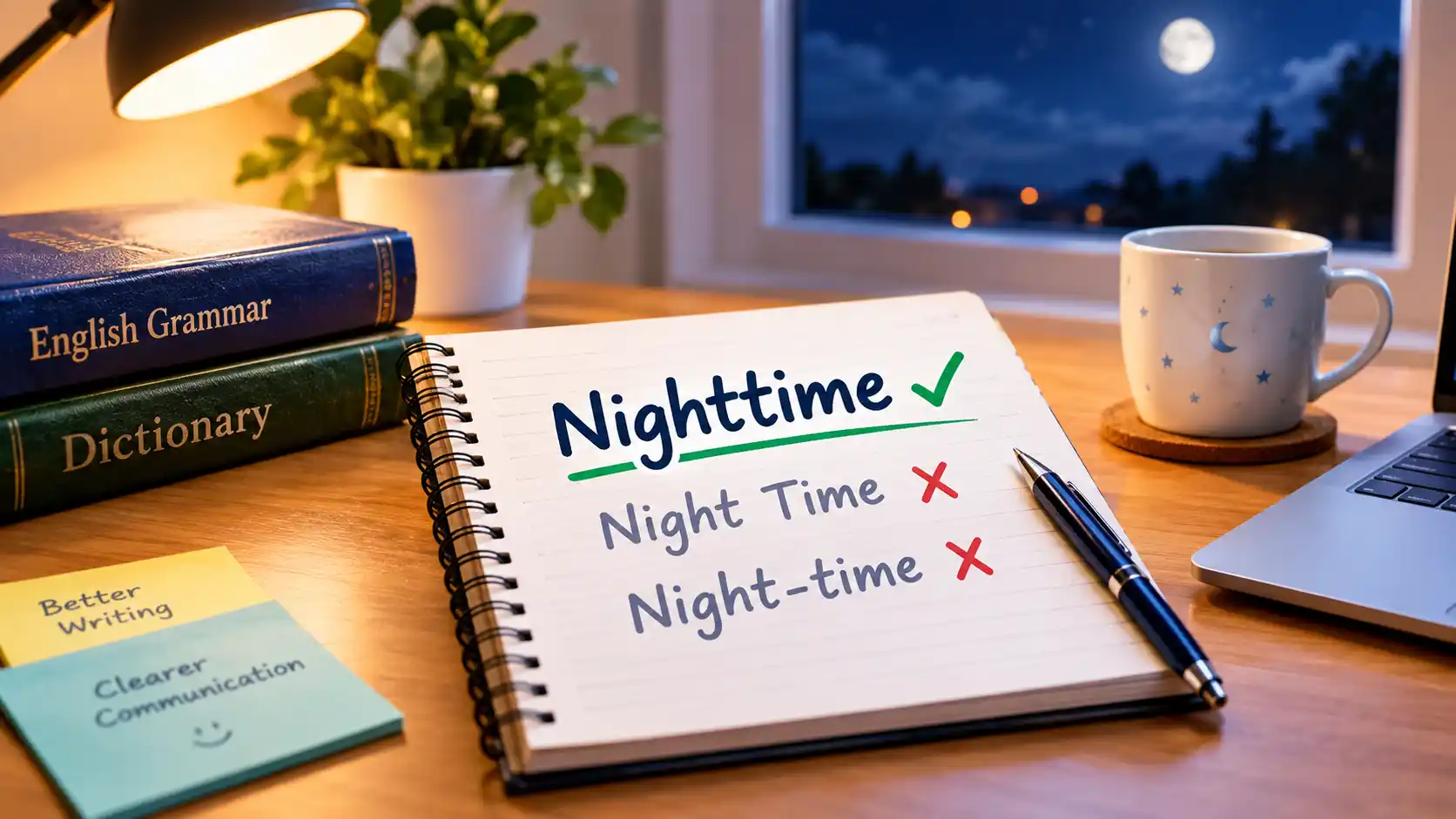
Have you ever stopped while writing and wondered whether nighttime or night time is the correct spelling? You are not alone. Both forms are easy to understand, and you may see them used in different books, websites, and everyday conversations.
The good news is that the answer is fairly simple. Nighttime is the standard one-word form used in modern English. However, you may also come across night-time, especially in some British English contexts, while night time can appear as an open phrase in certain situations.
Understanding the difference can help you write more naturally and confidently. Whether you are preparing a school assignment, writing a blog post, sending a professional email, or simply checking your spelling, knowing which form to choose makes your writing clearer.
In this guide, we will look at the correct spelling, the history of the word, British and American usage, common mistakes, examples, and frequently asked questions.
Nighttime or Night Time Quick Answer
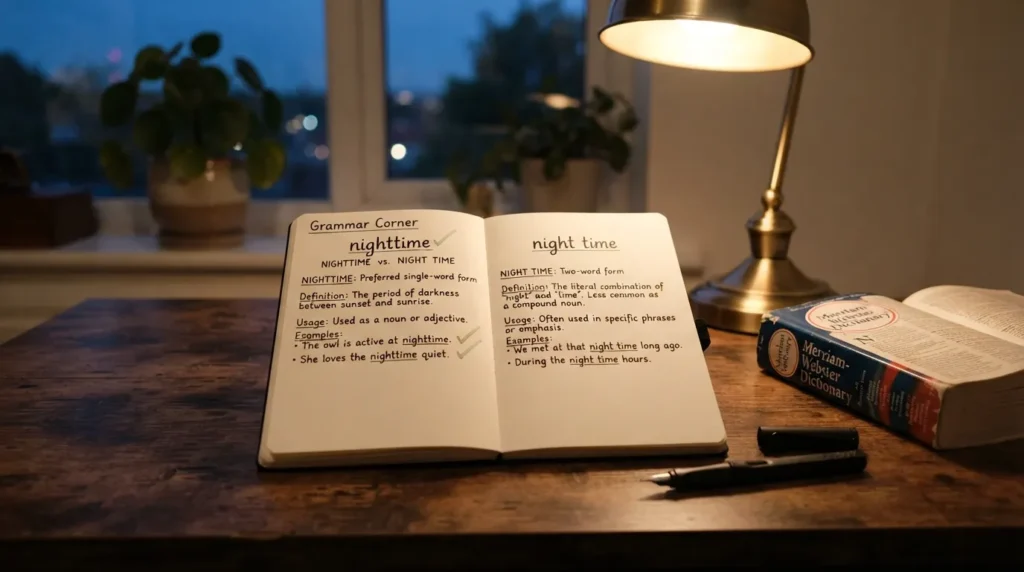
The simplest answer is nighttime.
When you are using the word to describe the period when it is dark, the one-word spelling is the most common modern choice. It works naturally as a noun and can also describe another noun.
For example:
- Nighttime is usually quiet in this neighborhood.
- I enjoy reading during nighttime.
- We went for a nighttime walk.
- The animals become more active at nighttime.
- She follows a relaxing nighttime routine.
The word night-time is also used, particularly in British English and some editorial styles. For example, you might see “night-time activities” or “night-time entertainment.”
The two-word form night time is understandable, but it is less common as the fixed compound. Therefore, if you are unsure which spelling to use, nighttime is generally the safest choice for modern writing.
The Origin of Nighttime

The word is made from two familiar English words: night and time.
English has a long history of turning frequently used word combinations into compounds. Some combinations remain as two words, some become hyphenated, and others eventually become a single word.
This is why English contains words such as:
- daytime
- bedtime
- lunchtime
- nighttime
The development of compound words is not always perfectly predictable. Writers and publishers may use different forms for years before one spelling becomes more widely accepted.
Older writing may therefore contain forms that look unusual to modern readers. Over time, nighttime became firmly established as a single word in contemporary English.
The same pattern can be seen in many other everyday words. English naturally changes as people use words repeatedly and familiar combinations become more closely connected.
So, although “night” and “time” are separate words on their own, nighttime functions as an established compound word.
British English vs American English Spelling
One reason this spelling question can be confusing is that English has regional differences.
American English strongly favors nighttime as one word. It is common in everyday writing, professional communication, articles, books, and general conversation.
British English also uses nighttime, but night-time can be found in British writing and some editorial styles. Oxford’s Advanced Learner’s Dictionary, for example, lists night-time as a noun meaning the time when it is dark.
Here is a simple comparison:
| Variety | Common Form |
| American English | nighttime |
| British English | nighttime / night-time |
| General modern writing | nighttime |
| Traditional British style | night-time |
If you are writing for an international audience, nighttime is a practical choice because it is widely recognized and easy to read.
The important thing is consistency. If you choose one spelling for an article or document, use that form throughout unless you are discussing the spelling differences themselves.
Which Spelling Should You Use?
For most writers, the easiest rule is:
Use “nighttime” as one word.
This is especially useful when you are writing:
- Blog posts
- School assignments
- Business content
- Website articles
- Social media posts
- Emails
- General informational content
- Everyday messages
For example:
Preferred:
I have a relaxing nighttime routine.
Less common:
I have a relaxing night time routine.
You may also encounter:
British-style:
I have a relaxing night-time routine.
The last version is not something you need to “correct” automatically if you are editing British English. Regional style matters.
However, if you simply want one spelling that works naturally in most modern situations, choose nighttime.
Common Mistakes with Nighttime
Although the word looks simple, writers sometimes make a few predictable mistakes.
1. Changing the spelling throughout the same article
A writer might use “nighttime” in one paragraph and “night time” in another without a reason.
This can make the writing look inconsistent.
Choose one standard form and stay with it.
2. Adding an unnecessary hyphen
Some writers automatically write “night-time” because they assume compound words need hyphens.
That is not always necessary. Nighttime is already an established closed compound.
3. Writing “night time routine”
The phrase “nighttime routine” is more natural in modern writing.
For example:
Better:
My nighttime routine helps me relax.
4. Confusing “nighttime” with “at night”
These expressions are related, but they are not always interchangeable.
Compare:
- Nighttime can be peaceful.
- I like reading at night.
The first sentence uses nighttime as a noun. The second uses “at night” as a natural phrase describing when something happens.
5. Assuming every variation is completely wrong
Language is more flexible than a simple right-or-wrong list sometimes suggests.
You may see night-time in British writing or night time in older or less formal material. That does not mean readers will misunderstand the sentence.
Still, for modern general writing, nighttime is usually the cleanest option.
“Nighttime” in Everyday Examples

Seeing the word in real sentences makes the difference easier to remember.
As a noun
- Nighttime is my favorite part of the day.
- The town becomes very quiet at nighttime.
- Nighttime can feel peaceful after a busy day.
- Some animals are especially active during nighttime.
- The temperature usually falls at nighttime.
Here, the word refers to the period of darkness.
As a modifier
Nighttime can also describe something associated with the night.
Examples include:
- nighttime routine
- nighttime activities
- nighttime temperatures
- nighttime walk
- nighttime journey
- nighttime sounds
- nighttime photography
- nighttime entertainment
For example:
The photographer enjoys capturing nighttime scenes.
Here, “nighttime” describes the type of scenes being discussed.
This is one reason the one-word form is useful. It works smoothly in many common expressions.
Nighttime or Night Time Usage and Modern Writing
The spelling you choose can affect how polished your writing feels.
Modern English frequently uses closed compound words. Words that once appeared separately can become more established as single words through repeated use.
That does not mean every two-word combination should automatically be joined together. English has many exceptions. However, nighttime is already a recognized compound, so there is little reason to keep separating it in ordinary modern writing.
For professional or educational content, the goal should be clarity and consistency.
Instead of repeatedly wondering whether to write “night time,” “night-time,” or “nighttime,” use the audience and writing style as your guide.
For general international content, nighttime is a strong default.
For British English, you may encounter night-time, particularly in publications that follow a house style using hyphens.
Most importantly, do not switch between forms randomly. Consistency makes an article easier to read.
Keyword Variation Comparison Table
| Variation | Typical Use | Recommendation |
| nighttime | Standard modern compound | Best general choice |
| night-time | British and some editorial styles | Acceptable depending on style |
| night time | Open phrase or less common usage | Use only when appropriate |
| at night | Natural phrase for time of day | Very common in everyday English |
The main takeaway is simple: nighttime is the safest general spelling when you mean the period of darkness.
The hyphenated form can be appropriate when following a particular British or editorial convention. Meanwhile, “at night” is often the most natural choice when you are simply describing when an action happens.
FAQs About Nighttime or Night Time
Is nighttime one word?
Yes. Nighttime is a standard one-word compound meaning the period when it is dark. It can function as a noun and can also modify another noun, such as in “nighttime activities.”
Is night time incorrect?
Not necessarily. The two-word form can still be encountered, but it is less common as the standard compound in modern general writing. If you are unsure, nighttime is usually the better choice.
Is night-time correct?
Yes. Night-time is a recognized form, especially in British English and certain editorial styles. Oxford’s Advanced Learner’s Dictionary lists “night-time” as a noun.
Which spelling is best for American English?
For American English, nighttime is the natural standard choice.
Which spelling is best for British English?
British English can use both nighttime and night-time, depending on the publication or style. If you are following a specific British style guide, follow its preferred convention.
Should I write “nighttime routine” or “night time routine”?
“Nighttime routine” is the more common modern form and is the better general choice.
Is nighttime a noun or an adjective?
It can be used as a noun and as a modifier.
As a noun:
Nighttime is peaceful.
As a modifier:
I enjoy my nighttime routine.
What is the difference between nighttime and at night?
“Nighttime” refers to the period of darkness, while “at night” is a common phrase used to describe when something happens.
For example:
Nighttime is peaceful.
and:
I study at night.
Both are natural, but they serve different grammatical purposes.
Which spelling should I use in a blog post?
For a general blog post, nighttime is the safest and most straightforward choice. It is concise, familiar, and widely accepted in modern English.
Conclusion
So, **nighttime or night time **Which one should you use?
For most modern English writing, nighttime is the best choice. It is an established compound word and works naturally as both a noun and a modifier.
You may still see night-time, particularly in British English or publications that follow a particular editorial style. The open form at night time can also appear, although it is less common as the fixed compound.
The easiest rule to remember is this: when you mean the period of darkness between evening and morning, write nighttime unless you are following a style that specifically prefers another form.
Once you remember this simple rule, you will not need to pause every time you type the word. Whether you are writing an article, assignment, email, or everyday message, choosing nighttime will usually give your writing a clean and modern feel.

Zainab Noor is a passionate content writer specializing in grammar and English language topics. With 2 years of experience, she creates clear, engaging, and SEO-friendly content that helps readers understand grammar, improve their writing skills, and use English with greater confidence.