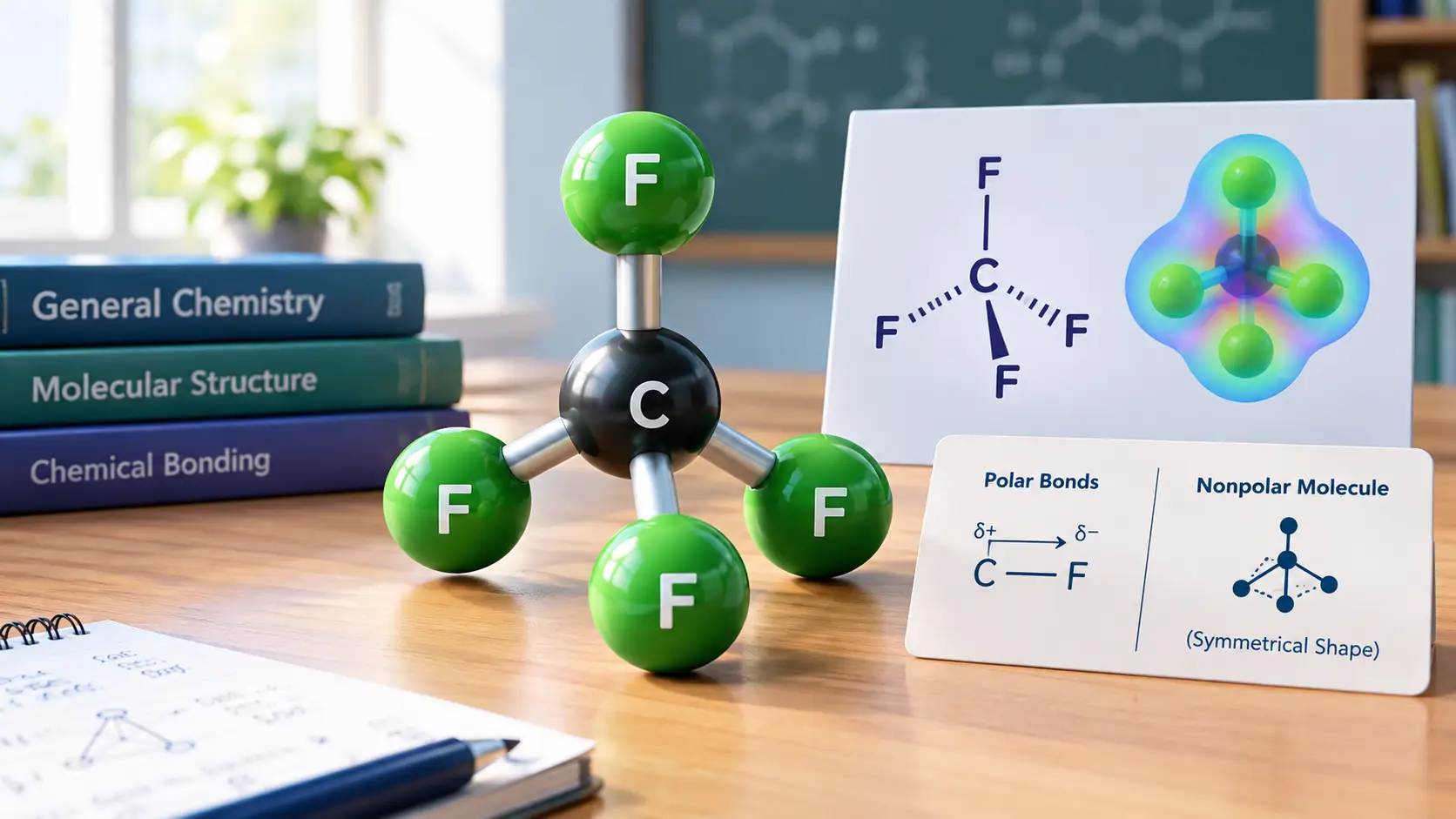
You’re staring at a chemistry worksheet. The question asks: is CF4 polar or nonpolar? The bonds inside it look polar. Fluorine is one of the most electronegative elements on the periodic table. So why does your textbook say the whole molecule is nonpolar?
This is one of the most confusing topics in intro chemistry. Students search for this answer because CF4, carbon tetrafluoride, seems like it should be polar. Each carbon-fluorine bond pulls electrons unevenly. But the molecule as a whole behaves differently than its individual bonds. This mix-up trips up many students preparing for exams like the AP Chemistry test or general chemistry finals.
The confusion comes down to one key idea: molecular shape matters as much as bond type. A molecule can have polar bonds and still be a nonpolar molecule overall, if its shape cancels out the pull in every direction.
This article gives you the quick answer, explains the science behind it, shows you how to check any molecule yourself, and clears up the common mistakes students make. By the end, you’ll understand not just the answer, but why it’s true.
CF4 Polar or Nonpolar Quick Answer
CF4 is nonpolar.
Here’s why in one sentence: CF4 has a symmetrical, tetrahedral shape, so the pull from each of the four polar C-F bonds cancels out in every direction, leaving no overall charge imbalance.
Quick comparison:
- Bonds inside CF4: Polar (carbon and fluorine have different electronegativities)
- Overall molecule: Nonpolar (symmetrical shape cancels the bond polarities)
This is a classic example teachers use to show that polar bonds don’t always create a polar molecule.
The Science Behind CF4’s Polarity
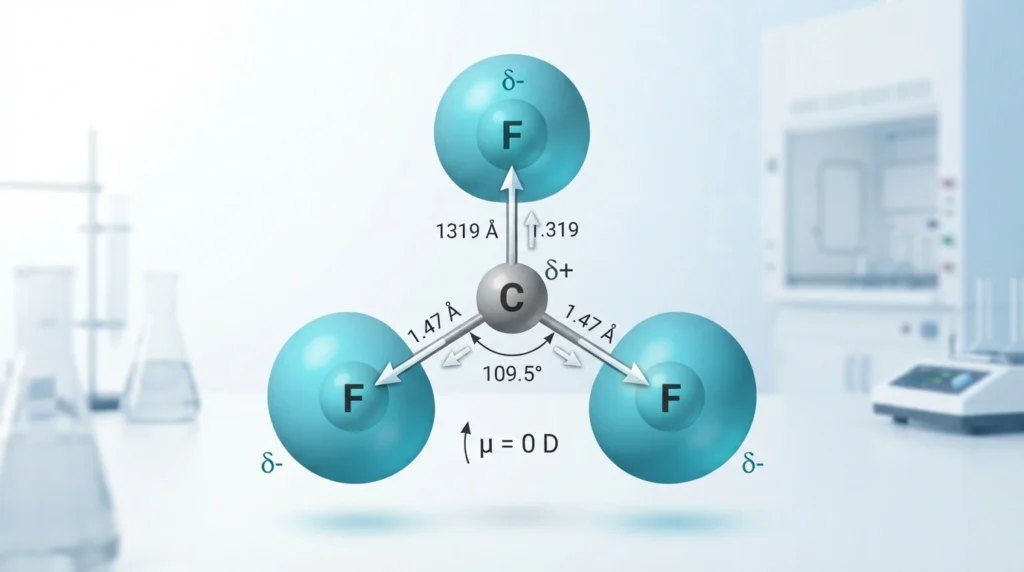
To understand why CF4 is nonpolar, you need two ideas: electronegativity and molecular geometry.
Electronegativity measures how strongly an atom pulls shared electrons toward itself. Fluorine is the most electronegative element that exists. Carbon is far less electronegative. This difference means each carbon-fluorine bond is polar, with electrons pulled toward fluorine.
Molecular geometry describes the 3D shape of a molecule. CF4 has a tetrahedral shape. Carbon sits in the center, with four fluorine atoms arranged symmetrically around it, each pointing to a corner of a tetrahedron, all at 109.5-degree angles from each other.
Because the four C-F bonds pull in four directions that are perfectly balanced and symmetrical, their individual pulls cancel each other out. Picture four people pulling equally hard on a rope from four evenly spaced directions. The rope doesn’t move. That’s what happens to the electron distribution in CF4. The result: no net dipole moment, and therefore, a nonpolar molecule.
Polar Bonds vs Nonpolar Molecules: How to Tell the Difference
Many students get stuck because they check only the bonds, not the whole molecule. Here’s how to properly evaluate any molecule.
| Factor | What to Check | Example |
| Bond polarity | Difference in electronegativity between atoms | C-F bond is polar |
| Molecular shape | Symmetry of atom arrangement | CF4 is tetrahedral (symmetrical) |
| Lone pairs on central atom | Presence of unshared electron pairs | CF4 has none on carbon |
| Net dipole moment | Do the bond pulls cancel out? | Yes, in CF4 |
| Final classification | Polar or nonpolar molecule | Nonpolar |
The rule: check the shape, not just the bonds. Symmetrical molecules with identical surrounding atoms and no lone pairs on the central atom tend to be nonpolar, even with polar bonds.
How to Determine Polarity Yourself (Step-by-Step Method)
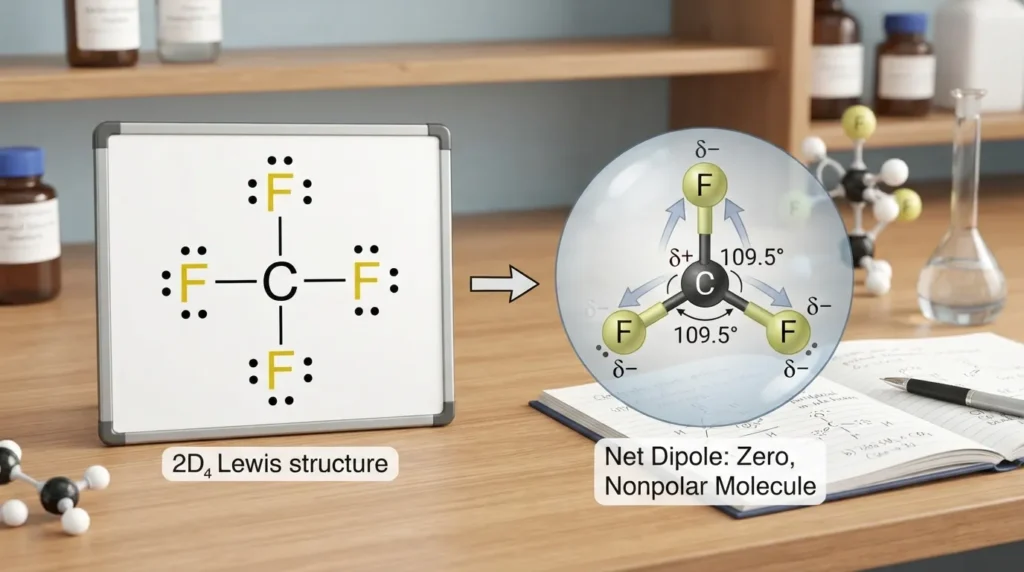
- For students: Draw the Lewis structure first. Identify the central atom, count bonding pairs and lone pairs, then determine the molecular shape using VSEPR theory. If the shape is symmetrical (like tetrahedral, linear, or trigonal planar with identical atoms around the center), the molecule is usually nonpolar.
- For exam prep: Memorize key symmetrical shapes that lead to nonpolar molecules: linear (like CO2), trigonal planar (like BF3), and tetrahedral (like CF4 or CH4).
- For general understanding: Remember that asymmetry causes polarity. If one side of a molecule has a different atom or a lone pair the other side doesn’t have, the molecule is usually polar.
Common Mistakes with CF4 Polarity

- Assuming polar bonds always mean a polar molecule : This is the most common error. Bond polarity and molecule polarity are separate ideas.
- Ignoring molecular shape : Students often skip drawing the 3D shape and jump straight to a guess.
- Confusing CF4 with molecules like CHF3: CHF3 is actually polar because it’s not symmetrical; one hydrogen replaces one fluorine, breaking the balance.
- Forgetting to check for lone pairs on the central atom — Lone pairs can create asymmetry and polarity, but carbon in CF4 has none.
- Mixing up electronegativity difference with molecular polarity — A large electronegativity difference creates a polar bond, not automatically a polar molecule.
CF4 Polarity in Everyday Examples
In a chemistry email to a professor:
“I understand that CF₄ is a nonpolar molecule because its symmetrical tetrahedral geometry causes the individual polar C–F bond dipoles to cancel completely.”
In science writing:
“Carbon tetrafluoride (CF₄) is an overall nonpolar molecule despite its polar C–F bonds. Its tetrahedral symmetry produces a balanced electron distribution, and CF₄ is also a potent greenhouse gas associated with industrial processes such as semiconductor manufacturing.”
In a student study group chat:
“CF₄ is nonpolar because its tetrahedral symmetry balances all four polar C–F bonds. Don’t let the bond polarity fool you the molecule’s overall shape determines its polarity.
In formal academic writing: “CF4 exhibits a nonpolar character despite the presence of highly polar C-F bonds, attributable to its symmetrical tetrahedral molecular geometry.”
CF4 Polar or Nonpolar Google Trends & Usage Data

Search interest in “CF4 polar or nonpolar” rises sharply during the school year, especially around exam periods for general chemistry and AP Chemistry courses. The United States shows the highest search volume, tied closely to standardized testing schedules like the SAT Subject Tests (historically) and AP exams in the spring.
Students also search variations like “is CF4 polar,” “CF4 molecular geometry,” and “CF4 Lewis structure,” often as part of the same study session while working through VSEPR theory homework. This keyword cluster consistently appears in chemistry tutoring resources and homework help platforms.
Keyword Variation Comparison Table
| Variation | Common Use | Search Context |
| CF4 polar or nonpolar | Most common search phrase | Homework, exam prep |
| Is CF4 polar | Direct question format | Quick fact-checking |
| CF4 molecular geometry | Broader structural question | Deeper study, shape analysis |
| CF4 Lewis structure | Step before polarity analysis | Drawing/diagramming help |
| Carbon tetrafluoride polarity | Formal/scientific naming | Academic papers, formal study |
FAQs
1. Is CF4 polar or nonpolar?
CF4 is nonpolar. Its symmetrical tetrahedral shape cancels out the pull from its four polar C-F bonds.
2. Are the bonds in CF4 polar or nonpolar?
The individual C-F bonds are polar because fluorine is much more electronegative than carbon.
3. Why is CF4 nonpolar if its bonds are polar?
Because CF4 has a symmetrical tetrahedral shape. The four identical bond pulls cancel each other out, leaving no net dipole moment.
4. What shape is CF4?
CF4 has a tetrahedral molecular geometry, with carbon at the center and four fluorine atoms at the corners.
5. Is CF4 similar to CH4 in polarity?
Yes. Both CF4 and CH4 (methane) are nonpolar because both have symmetrical tetrahedral shapes with four identical surrounding atoms.
6. Does CF4 have any lone pairs affecting its shape?
No. Carbon in CF4 has no lone pairs, which helps keep the molecule perfectly symmetrical and nonpolar.
7. What makes a molecule polar instead of nonpolar?
A molecule is polar when its shape is asymmetrical, or when it has lone pairs or different atoms creating an uneven charge distribution across the molecule.
Conclusion
CF4 is nonpolar, even though its individual carbon-fluorine bonds are polar. The key reason is molecular shape: CF4’s symmetrical tetrahedral geometry causes the pull from each bond to cancel out completely, leaving no net charge imbalance across the molecule.
This is one of the clearest examples in chemistry showing that polar bonds don’t automatically create a polar molecule. Shape and symmetry decide the final answer, not just the electronegativity difference between atoms. Understanding this distinction helps with countless other molecules on exams, from CH4 to CO2 to more complex compounds.
Whether you’re studying for a chemistry exam, double-checking homework, or just curious, remember the two-step check: identify the bond polarity, then confirm the molecular shape. If the shape is symmetrical, like CF4’s tetrahedral structure, the molecule is nonpolar overall.

Zainab Noor is a passionate content writer specializing in grammar and English language topics. With 2 years of experience, she creates clear, engaging, and SEO-friendly content that helps readers understand grammar, improve their writing skills, and use English with greater confidence.