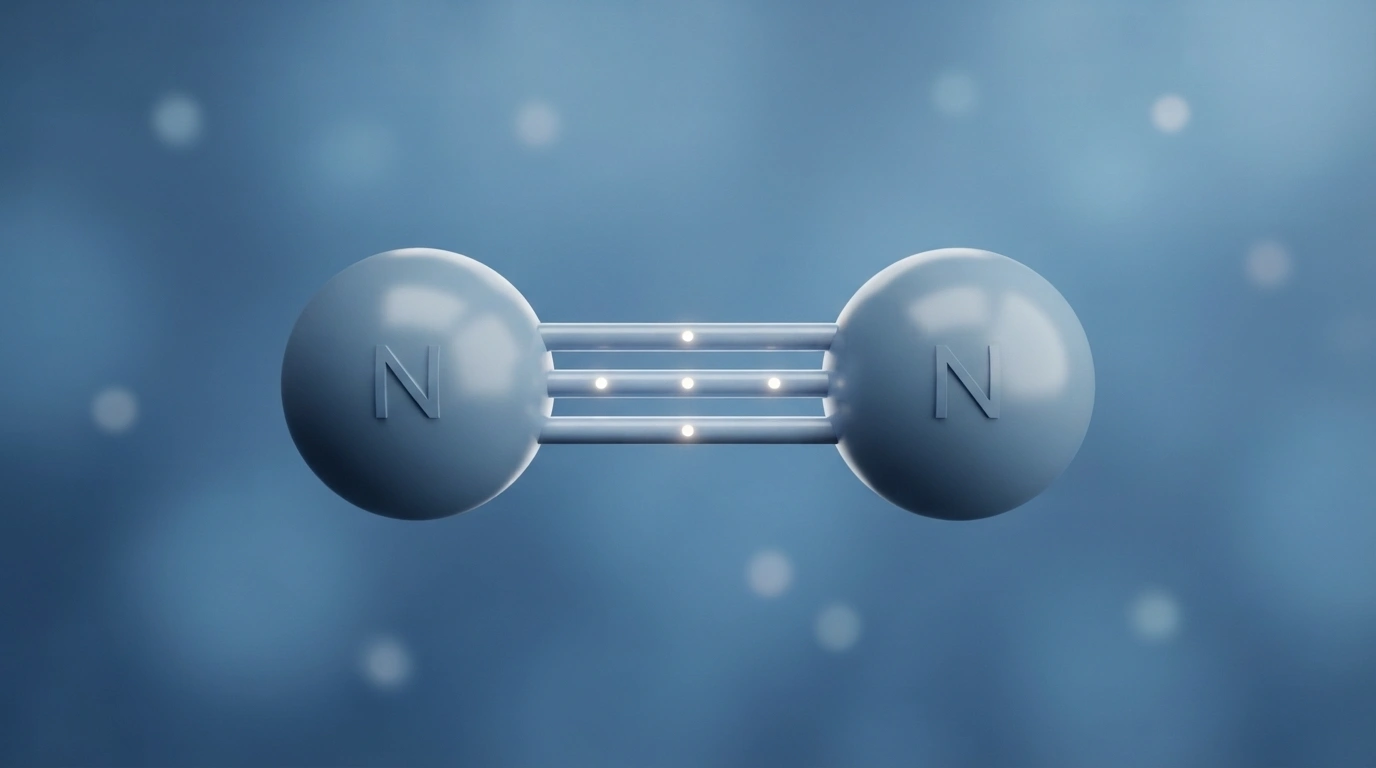
You’re working through a chemistry worksheet, and the question asks: is N2 polar or nonpolar? At first glance, it might seem tricky, nitrogen gas is such a basic, common molecule that surely it must have some kind of charge difference, right?
This is one of the simpler polarity questions in chemistry, but it still trips up many students, especially when comparing it to more complex molecules like water or ammonia. People search for this while studying for exams like AP Chemistry, general chemistry finals, or homework covering molecular bonding and polarity.
The confusion often comes from not fully understanding why identical atoms bonded together behave differently than atoms of different elements. Once you understand the core rule behind this, N2’s polarity becomes one of the easiest concepts to remember in your entire chemistry course.
This article gives you the quick answer, explains the science behind it clearly, shows you how to verify it yourself, and clears up common mistakes students make when comparing N2 to other molecules. By the end, you’ll fully understand not just the answer, but exactly why it’s true.
N2 Polar or Nonpolar Quick Answer
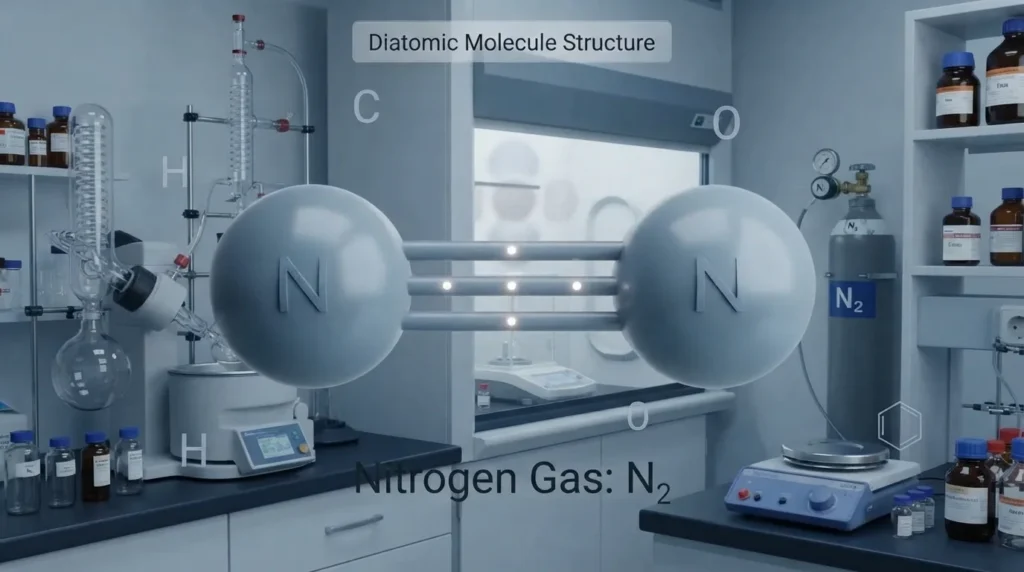
N2 (nitrogen gas) is nonpolar.
Here’s why in one sentence: N2 consists of two identical nitrogen atoms bonded together, so there is no difference in electronegativity between them, meaning no unequal pull on shared electrons and no charge separation anywhere in the molecule.
Quick comparison:
- Bond type in N2: Nonpolar covalent bond (triple bond between two identical atoms)
- Overall molecule: Nonpolar (no electronegativity difference, no dipole moment)
N2 is one of the simplest examples of a nonpolar molecule because it involves only one type of element.
The Science Behind N2’s Polarity

To understand why N2 is nonpolar, you need to look at electronegativity and bond symmetry.
Electronegativity measures how strongly an atom pulls shared electrons toward itself. When two atoms of the same element bond together, like the two nitrogen atoms in N2, they have identical electronegativity values. Neither atom pulls harder than the other, so the shared electrons in the bond are distributed perfectly evenly between them.
N2 is held together by a triple covalent bond, one of the strongest bonds in chemistry, but the type of bond doesn’t change the polarity outcome here. Since both atoms are identical, there’s no electronegativity difference at all, which means there’s no partial positive or partial negative charge anywhere in the molecule.
This is different from molecules like CF4, which have polar bonds that cancel out due to symmetry. N2 doesn’t need symmetry to become nonpolar, its bonds are already nonpolar to begin with, because the two atoms sharing electrons are exactly the same element.
Polar Bonds vs Nonpolar Molecules: How to Tell the Difference
Understanding N2 becomes easier when you compare it to molecules that do have polar bonds.
| Factor | What to Check | N2 Example |
| Atoms involved | Are the atoms in the bond identical or different? | Both atoms are nitrogen (identical) |
| Electronegativity difference | Is there any difference between atoms? | None; electronegativity is equal |
| Bond type | Polar or nonpolar covalent bond? | Nonpolar covalent bond |
| Molecular shape | Linear, symmetrical, or asymmetrical? | Linear, but shape isn’t even needed here |
| Final classification | Polar or nonpolar molecule | Nonpolar |
The key rule: any molecule made of two identical atoms bonded together (called a diatomic molecule) is automatically nonpolar, since there’s no electronegativity difference to create any charge imbalance.
How to Determine Polarity Yourself (Step-by-Step Method)
- For students: First, identify whether the molecule involves identical atoms (like N2, O2, or Cl2) or different atoms (like CF4 or H2O). If the atoms are identical, the molecule is automatically nonpolar, no need to analyze shape.
- For exam prep: Memorize the common nonpolar diatomic molecules: H2, N2, O2, F2, Cl2, Br2, and I2. These are all made of two identical atoms and are always nonpolar.
- For general understanding: Remember that polarity requires an uneven pull on electrons. If both atoms in a bond are identical, that pull is always equal, so there’s no polarity to worry about, regardless of shape or bond strength.
Common Mistakes with N2 Polarity
- Assuming a triple bond automatically means something special about polarity : Bond strength (single, double, or triple) has no direct effect on whether a bond is polar or nonpolar; that depends only on electronegativity difference.
- Confusing N2 with polar nitrogen-containing molecules : Compounds like NH3 (ammonia) or NO (nitric oxide) are polar because they involve different elements bonded to nitrogen, unlike N2, which only contains nitrogen atoms.
- Overcomplicating simple diatomic molecules : Some students try to apply shape-based reasoning (like they would for CF4) to N2, when the identical-atom rule already settles the answer immediately.
- Forgetting that N2 makes up most of Earth’s atmosphere : This is a helpful real-world fact that often appears alongside polarity questions in environmental science contexts.
- Mixing up “nonpolar molecule” with “no bond at all” : N2 still has a very strong triple bond between its atoms; nonpolar simply means the electron distribution is even, not that there’s no bond.
N2 Polarity in Everyday Examples

In a chemistry email to a professor: “I understand N2 is nonpolar because both nitrogen atoms are identical, so there’s no electronegativity difference to create a dipole.”
In science news: “Nitrogen gas, which makes up about 78% of Earth’s atmosphere, is a stable, nonpolar molecule due to its strong triple covalent bond.”
In a student study group chat: “N2 is nonpolar because it’s just two nitrogen atoms bonded together. No difference in electronegativity means no polarity.”
In formal academic writing: “Molecular nitrogen (N2) exhibits nonpolar characteristics as a result of its homonuclear diatomic structure, wherein both atoms share identical electronegativity values.”
N2 Polar or Nonpolar Google Trends & Usage Data
Search interest in “N2 polar or nonpolar” rises during the school year, particularly around general chemistry coursework covering molecular bonding, electronegativity, and the periodic table. The United States shows the highest search volume, closely tied to standardized testing schedules like AP Chemistry exams in the spring semester.
Students often search this question alongside related terms like “is N2 a diatomic molecule,” “N2 Lewis structure,” and “nonpolar diatomic molecules list,” typically while completing homework related to VSEPR theory or basic bonding concepts. This keyword cluster appears frequently across chemistry tutoring websites and homework help platforms.
Keyword Variation Comparison Table
| Variation | Common Use | Search Context |
| N2 polar or nonpolar | Most common search phrase | Homework, exam prep |
| Is N2 polar | Direct question format | Quick fact-checking |
| N2 Lewis structure | Structural analysis question | Diagramming, bonding practice |
| Nonpolar diatomic molecules | Broader category search | Studying related molecules |
| Nitrogen gas polarity | Formal/scientific naming | Academic papers, formal study |
FAQs
1. Is N2 polar or nonpolar?
N2 is nonpolar because it consists of two identical nitrogen atoms with no electronegativity difference between them.
2. Why is N2 nonpolar even though it has a triple bond?
Bond strength doesn’t affect polarity. Polarity depends on electronegativity difference, and since both atoms in N2 are identical, there is none.
3. What type of bond does N2 have?
N2 has a nonpolar covalent triple bond between its two nitrogen atoms.
4. Are all diatomic molecules nonpolar?
Only diatomic molecules made of identical atoms (like N2, O2, or H2) are nonpolar. Diatomic molecules made of different atoms (like CO or HCl) are polar.
5. Why is N2 so common in the atmosphere?
N2 makes up about 78% of Earth’s atmosphere. Its strong triple bond and nonpolar, stable structure make it relatively unreactive under normal conditions.
6. Is N2 the same as NH3 in terms of polarity?
No. N2 is nonpolar because it contains only nitrogen atoms. NH3 (ammonia) is polar because it contains different elements (nitrogen and hydrogen) arranged in an asymmetrical shape.
7. Do I need to check the molecular shape to determine N2’s polarity?
No. Since N2 is made of two identical atoms, it’s automatically nonpolar regardless of shape, unlike molecules with different atoms, where shape often matters.
Conclusion
N2 is nonpolar because it consists of two identical nitrogen atoms bonded together by a strong triple covalent bond. Since both atoms share the exact same electronegativity, there’s no unequal pull on the shared electrons, meaning no partial charges form anywhere in the molecule.
This makes N2 one of the simplest polarity examples in chemistry: any molecule made of two identical atoms is automatically nonpolar, no need to analyze molecular shape or symmetry the way you would with more complex molecules like CF4 or H2O.
Whether you’re studying for a chemistry exam or just curious about the air you breathe, remember this simple rule: identical atoms bonded together always share electrons equally, resulting in a nonpolar molecule. This single concept will help you quickly identify the polarity of many other diatomic molecules you’ll encounter in your studies.

Zainab Noor is a passionate content writer specializing in grammar and English language topics. With 2 years of experience, she creates clear, engaging, and SEO-friendly content that helps readers understand grammar, improve their writing skills, and use English with greater confidence.