You want to describe something as feminine, playful, or typical of girls, but then you stop: should you write “girly” or “girlie”? Both forms look familiar, and both appear in English writing. So which one should you choose?
This spelling question often appears in searches because girly and girlie have the same basic meaning and are pronounced the same way. However, their use can vary by context, style, and region. For example, you may see “girly clothes,” “girlie dresses,” “girly things,” or “girlie weekend.” Dictionaries recognize both forms, so this is not simply a case of one spelling being wrong.
The main challenge is knowing which form sounds more natural for your audience. In modern general writing, girly is a common choice, while girlie also appears, especially in certain British expressions and fixed phrases. The words can also carry different tones depending on context.
This guide explains girly or girlie, their meanings, spelling patterns, regional use, common mistakes, and everyday examples. By the end, choosing the right form will be much easier.
Girly or Girlie – Quick Answer
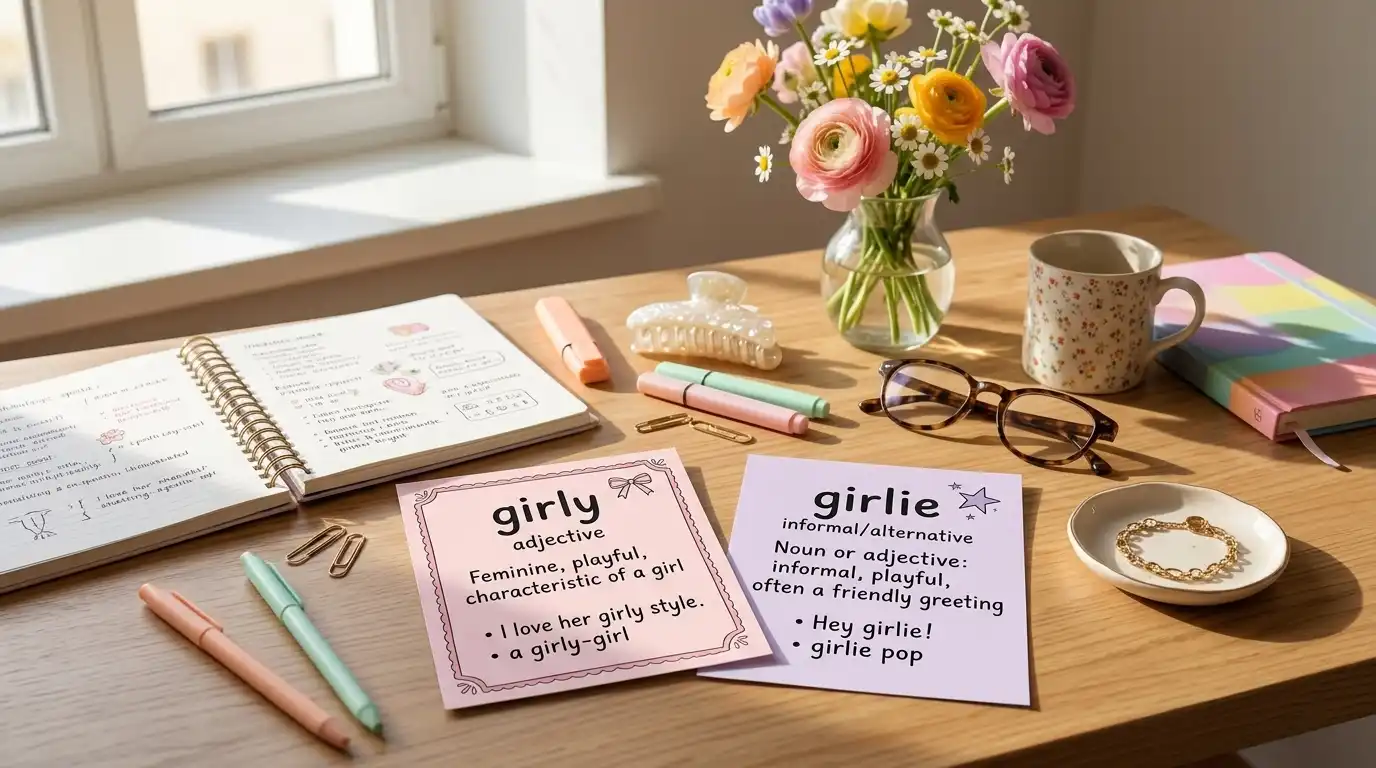
Both “girly” and “girlie” are correct spellings. They are variants used as adjectives and, in informal contexts, as nouns.
As adjectives, both can describe something considered typical of girls or women:
- Girly: “She loves girly colors and floral designs.”
- Girlie: “She chose a girlie dress with soft colors and ruffles.”
Cambridge lists girlie as a variant of girly and gives examples such as “girly stuff,” “girly things,” “girlie chat,” and “girly weekend.”
Oxford also lists girlie as another form of girly. Its learner dictionary notes that girly can describe something thought to be suitable for or typical of girls.
So, if you are asking “Is girly or girlie correct?”, the short answer is: both are correct.
In most general writing, girly is a simple and widely understood choice. However, girlie is also established English and may sound more natural in some phrases or varieties of English.
The Origin of “Girly” and “Girlie”

The spelling difference comes from English word formation rather than from two completely unrelated words.
The base word is girl. English commonly creates adjectives by adding suffixes to nouns. The ending -y can mean “having the quality of” or “characterized by.” Oxford’s information on the -y suffix gives examples such as “dusty,” “cakey,” and “girlie.”
The form girly is therefore a natural formation from girl + -y. It developed as a word for something associated with girls or considered typical of girls.
Girlie uses a slightly different spelling pattern. The ending -ie can also occur in informal or descriptive formations. English has many words with alternative endings such as -y, -ie, or -ey, especially in informal vocabulary.
Over time, girly and girlie became established variants. They are not simply a modern spelling mistake. Major dictionaries now recognize both forms. Cambridge lists “girlie” as a variant of “girly,” while Oxford also identifies the alternative spelling.
There is another important point: girlie can have more than one sense. Oxford notes a use for “girlie magazines,” while Cambridge also records this older meaning. Because that sense can be dated or inappropriate in some contexts, writers should consider the surrounding words carefully.
British English vs American English Spelling

There is no strict American-versus-British spelling rule that says one country must use “girly” and the other must use “girlie.”
Both forms are recognized in English dictionaries. Cambridge lists girlie as an alternative to girly, and its examples include specifically British expressions such as “girlie chat” and “girly weekend.”
Oxford’s American English dictionary also lists girlie and says it is “also girly,” showing that the alternative spelling is not limited to British English.
| Meaning or Use | American English | British English |
| Typical of girls | girly / girlie | girly / girlie |
| Feminine style | girly / girlie | girly / girlie |
| “Girly things” | girly | girly |
| “Girlie chat” | Less typical | Common expression |
| Informal variant | girlie | girlie |
| Most neutral general choice | girly | girly |
The key difference is therefore usage and tone, not a fixed spelling rule.
For example:
- US: “She loves girly clothes.”
- UK: “We had a girlie chat after dinner.”
These are both understandable, but the second expression may feel more natural in British English.
Which Spelling Should You Use?
US Writers
For American readers, girly is a clear and natural choice in most everyday writing.
Examples include:
- “She has a very girly style.”
- “They planned a girly movie night.”
- “The room has a cute, girly design.”
Girlie is also valid, but it may feel more informal or stylistically marked depending on the sentence.
UK and Commonwealth Writers
British and Commonwealth readers understand both spellings. However, girlie appears naturally in some informal British expressions, such as “girlie chat” and “girlie weekend.” Cambridge specifically provides these examples.
Still, girly remains a normal and widely understood form.
Global and Academic Writers
For international or professional writing, choose the form that sounds clearest for your audience. In many cases, girly is the simpler option.
Also consider If the word is necessary. Terms such as feminine, youthful, playful, or girlish may sometimes communicate your meaning more precisely.
For example:
- “She wore a girly dress.”
- “She wore a feminine dress.”
The second sentence may be more suitable in formal writing if you want a neutral description.
Common Mistakes with “Girly” and “Girlie”

- Assuming “girlie” is always wrong : It is not. Dictionaries recognize “girlie” as a variant of “girly.”
- Assuming “girly” is only American English : This is also incorrect. “Girly” is used in British English as well.
- Treating the two forms as completely different words : In their main adjective use, they are spelling variants with the same basic meaning.
- Using “girlie” without checking the context : “Girlie” can occur in older expressions with meanings that may not fit modern professional writing. Oxford identifies “girlie magazines” as an older use.
- Using “girly” when “girlish” is more precise : “Girlish” can describe behavior or qualities associated with a girl, such as “a girlish laugh.”
- Assuming spellcheck will choose the better word : Both spellings are legitimate, so spellcheck may accept either one. The writer must choose based on meaning, tone, and audience.
Girly and Girlie in Everyday Examples

In Emails
“Would you prefer a more girly design for the invitation, or should we keep it simple?”
Here, girly describes a design associated with feminine or traditionally girl-oriented styles.
In News
“The brand’s new collection uses bright colors and playful details to create a girly aesthetic.”
In a news or feature article, the writer may use girly to describe a style or trend.
In Social Media
“Planning a cute, girlie weekend with my best friends!
Here, girlie gives the caption an informal and friendly tone.
In Formal Writing
“The collection uses colors and patterns traditionally associated with feminine fashion.”
In formal writing, feminine may be clearer than either “girly” or “girlie.”
In Casual Conversation
“We had a really girly afternoon coffee, shopping, and lots of talking.”
This is informal and natural because the word describes activities traditionally associated with girls or women.
In a Personal Description
“She has a playful, girly style.”
This sentence uses girly as an adjective to describe a personal style.
Girly or Girlie – Google Trends & Usage Data
People search for “girly or girlie” because both spellings appear online and in everyday English. The important point is that search interest alone does not determine If a spelling is correct.
Google Trends measures relative search interest, allowing users to explore how search behavior changes over time and across locations.
For this word pair, usage can vary by context. Searches may come from people checking:
- Fashion descriptions
- Social media captions
- “Girly” or “girlie” aesthetics
- Informal conversations
- British expressions
- Spelling and grammar questions
The word girly is especially common in phrases describing style, colors, hobbies, or things traditionally associated with girls. Cambridge gives examples such as “girly stuff” and “girly things.”
Meanwhile, girlie appears in expressions such as “girlie chat” and “girly weekend,” particularly in British usage.
Because Google Trends reports relative interest rather than a simple dictionary-style measure of correctness, it should be used to study search behavior rather than decide which spelling is “correct.”
Keyword Variation Comparison Table
| Variation | Meaning | Common Use |
| Girly | Typical of or associated with girls | Style, fashion, hobbies, personality |
| Girlie | Alternative form of girly | Informal speech, expressions, style |
| Girlish | Like a girl or characteristic of a girl | Behavior, voice, appearance |
| Girl | A female child or young woman | General noun |
| Girly girl | A girl or woman described as strongly enjoying traditionally feminine things | Informal conversation |
Cambridge and Oxford both recognize girly and girlie as related forms, while Oxford separately defines girlish as meaning “like a girl” or “of a girl.”
FAQs
1. Is “girly” or “girlie” correct?
Both girly and girlie are correct. They are recognized spelling variants, especially when used as adjectives to describe something associated with girls or women.
2. Is “girly” more common than “girlie”?
Girly is a very common general form, but girlie is also established in English. The choice often depends on context, style, and regional usage.
3. Is “girlie” British English?
“Girlie” is used in British English, and some expressions such as “girlie chat” are particularly associated with UK usage. However, “girlie” is not exclusively British; American English dictionaries also recognize it.
4. Is “girly” an American spelling?
No. Girly is used in both American and British English. It is not an American-only spelling.
5. What is the difference between “girly” and “girlish”?
They are similar, but girlish often means “like a girl” or “characteristic of a girl,” while girly is more informal and can describe things considered typical of girls. Oxford gives examples such as “a girlish giggle” and “a girlish figure.”
6. Is “girlie” a real word?
Yes. Major dictionaries recognize girlie as a real English word and as a variant of girly.
7. Which spelling should I use in professional writing?
Girly is usually the straightforward choice if you need this informal adjective. However, in formal writing, consider If words such as feminine, youthful, or girlish would communicate the idea more precisely.
Conclusion
Girly and girlie are both correct English spellings. They share the same main idea: describing something considered typical of girls or associated with feminine style or interests. Major dictionaries recognize both forms, so you do not need to treat girlie as a spelling mistake.
For most general writing, girly is a simple and clear choice. Girlie is also useful, especially in informal expressions and some British English contexts. For example, “girly things” and “girlie chat” are both established expressions.
The best choice depends on your audience, tone, and sentence. If you are writing for a broad audience, girly is often the easiest option. If a familiar phrase naturally uses girlie, there is no need to change it.
Finally, remember that girlish is another related word with a slightly different use. It can mean “like a girl” or “of a girl.”
By focusing on meaning and context rather than assuming one spelling is always correct, you can use girly, girlie, and girlish with confidence.

Haleema Sadia is a passionate content writer specializing in wishes, greetings, messages, and heartfelt quotes. With 3 years of experience, she creates warm, engaging, and SEO-friendly content that helps readers find the perfect words to celebrate special moments and express their feelings.