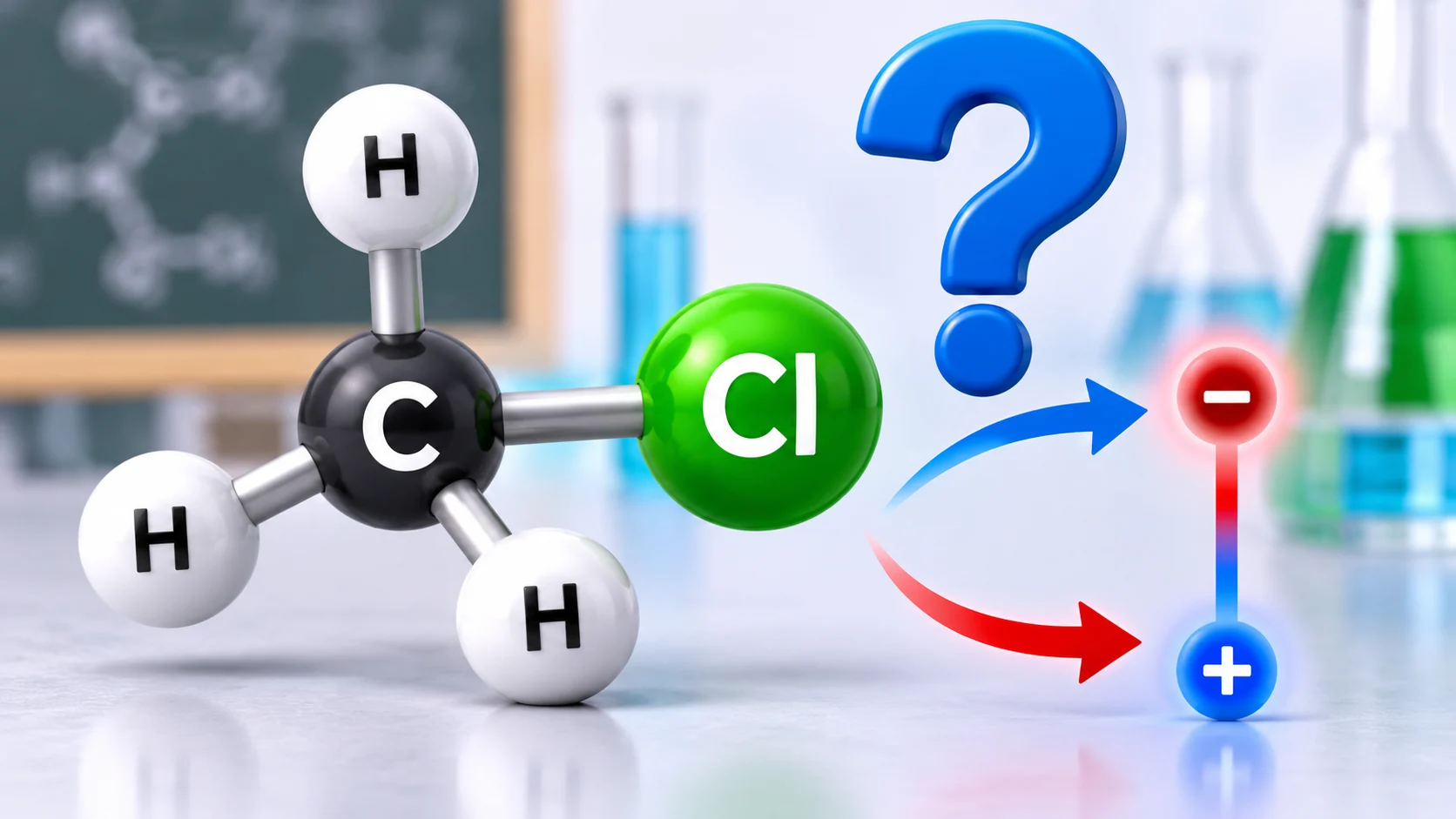
You are staring at a chemistry worksheet. It asks if CH3Cl is polar or nonpolar. You know the formula. You even know what carbon, hydrogen, and chlorine are. But putting it together to answer this one question feels harder than it should.
This is one of the most searched chemistry questions in general chemistry and organic chemistry courses. Students search “CH3Cl polar or nonpolar” because textbooks often explain polarity using rules and formulas, but do not always show how those rules apply to one specific molecule, step by step. This creates a gap between knowing the theory and answering the actual question on the test.
The confusion usually comes from one tricky idea: shape and electronegativity both matter, and a molecule can look “balanced” while still being polar overall. CH3Cl is a great example of this, since it is not perfectly symmetrical like some molecules students learn first.
In this guide, you will get a quick answer first. Then you will see exactly why CH3Cl is polar, how it compares to similar molecules, common mistakes, real examples of where this shows up, and answers to frequent student questions.
CH3Cl Polar or Nonpolar Quick Answer
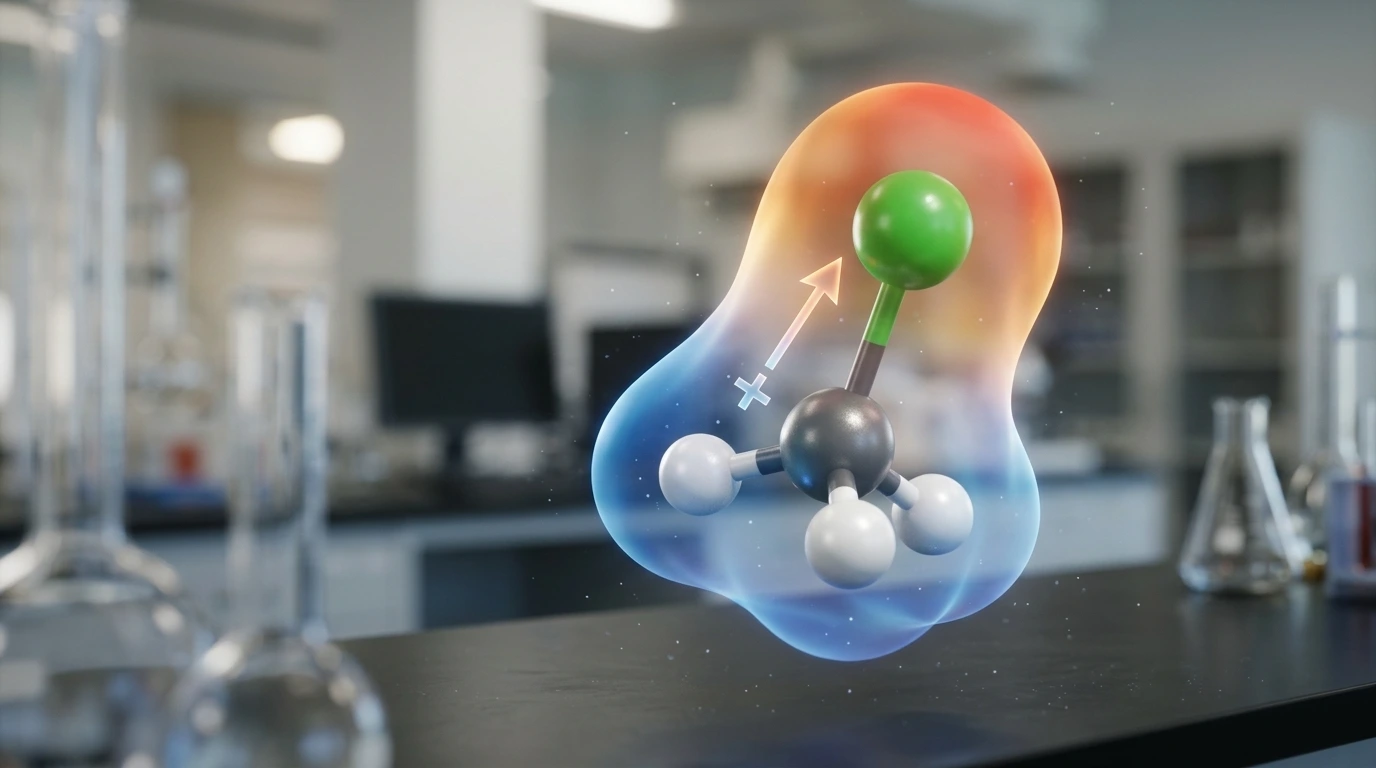
CH3Cl (chloromethane) is polar.
Here is why, in simple terms:
- Carbon (C) and chlorine (Cl) do not share electrons equally. Chlorine pulls electrons harder, since it is more electronegative.
- Carbon and hydrogen (H) share electrons almost equally, so the C–H bonds are only slightly polar.
- The molecule has a tetrahedral shape, but it is not symmetrical, since one side has a hydrogen and the other side has a chlorine.
- Because the shape is uneven and the C–Cl bond is strongly polar, the bond dipoles do not cancel out.
Example comparison:
- CH4 (methane): nonpolar, because all four bonds are C–H and the shape is perfectly symmetrical.
- CH3Cl (chloromethane): polar, because one C–H bond is replaced with a stronger C–Cl bond, breaking the balance.
Why Is CH3Cl Polar? (Electronegativity and Molecular Shape)
To understand CH3Cl, you need two ideas: electronegativity and molecular shape.
Electronegativity is how strongly an atom pulls shared electrons toward itself. Chlorine has a much higher electronegativity than both carbon and hydrogen. This means the electrons in the C–Cl bond spend more time near the chlorine atom, giving that end of the bond a slightly negative charge and the carbon end a slightly positive charge. This is called a bond dipole.
Molecular shape matters just as much as the bonds themselves. CH3Cl has a tetrahedral shape, with carbon in the center and four atoms around it: three hydrogens and one chlorine. In a molecule like CH4, all four positions hold the same kind of atom (hydrogen), so the bond dipoles point outward evenly and cancel each other out. The result is a nonpolar molecule.
In CH3Cl, one position holds chlorine instead of hydrogen. Since chlorine pulls much harder on its shared electrons than hydrogen does, the bond dipoles no longer balance out. There is a net pull toward the chlorine side of the molecule. This uneven pull is called a net dipole moment, and it makes the whole molecule polar, not just one bond.
Simple way to remember it: Different atoms around the central carbon almost always break the balance needed for a nonpolar molecule, especially when one of those atoms is much more electronegative than the rest.
CH3Cl vs Other Methane Derivatives (Polarity Comparison)
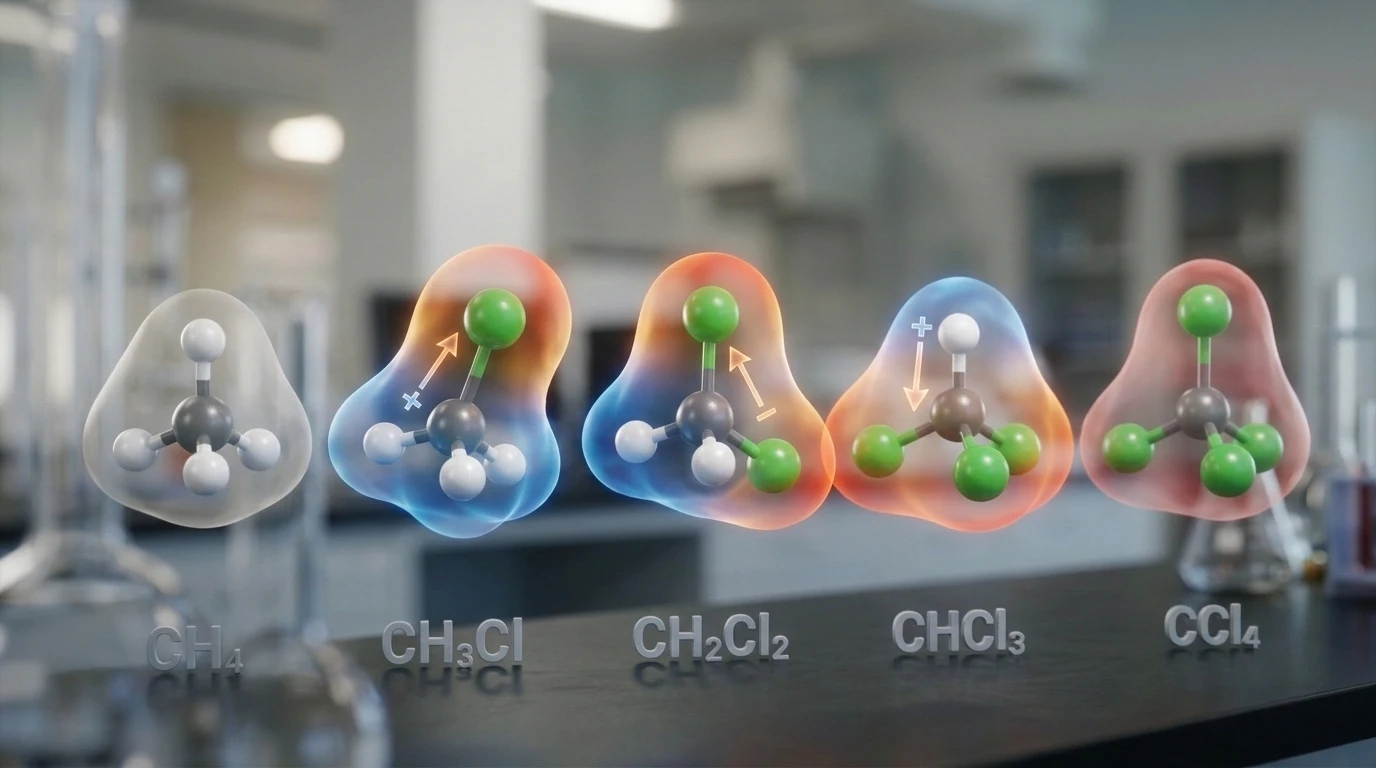
Comparing CH3Cl to related molecules makes the pattern much easier to see.
| Molecule | Formula | Shape | Polar or Nonpolar? | Why |
| Methane | CH4 | Tetrahedral | Nonpolar | All four bonds are C–H, symmetrical, dipoles cancel |
| Chloromethane | CH3Cl | Tetrahedral | Polar | One C–Cl bond breaks the symmetry |
| Dichloromethane | CH2Cl2 | Tetrahedral | Polar | Two C–Cl bonds, still unevenly arranged |
| Chloroform | CHCl3 | Tetrahedral | Polar | Three C–Cl bonds, still unevenly arranged |
| Carbon tetrachloride | CCl4 | Tetrahedral | Nonpolar | All four bonds are C–Cl, symmetrical again |
Key pattern: CH4 and CCl4 are both nonpolar, since all four substituents around carbon are identical. Every molecule in between, like CH3Cl, CH2Cl2, and CHCl3, is polar, because the mix of different atoms breaks the symmetry needed for the dipoles to cancel.
How to Determine Polarity: A Step-by-Step Method
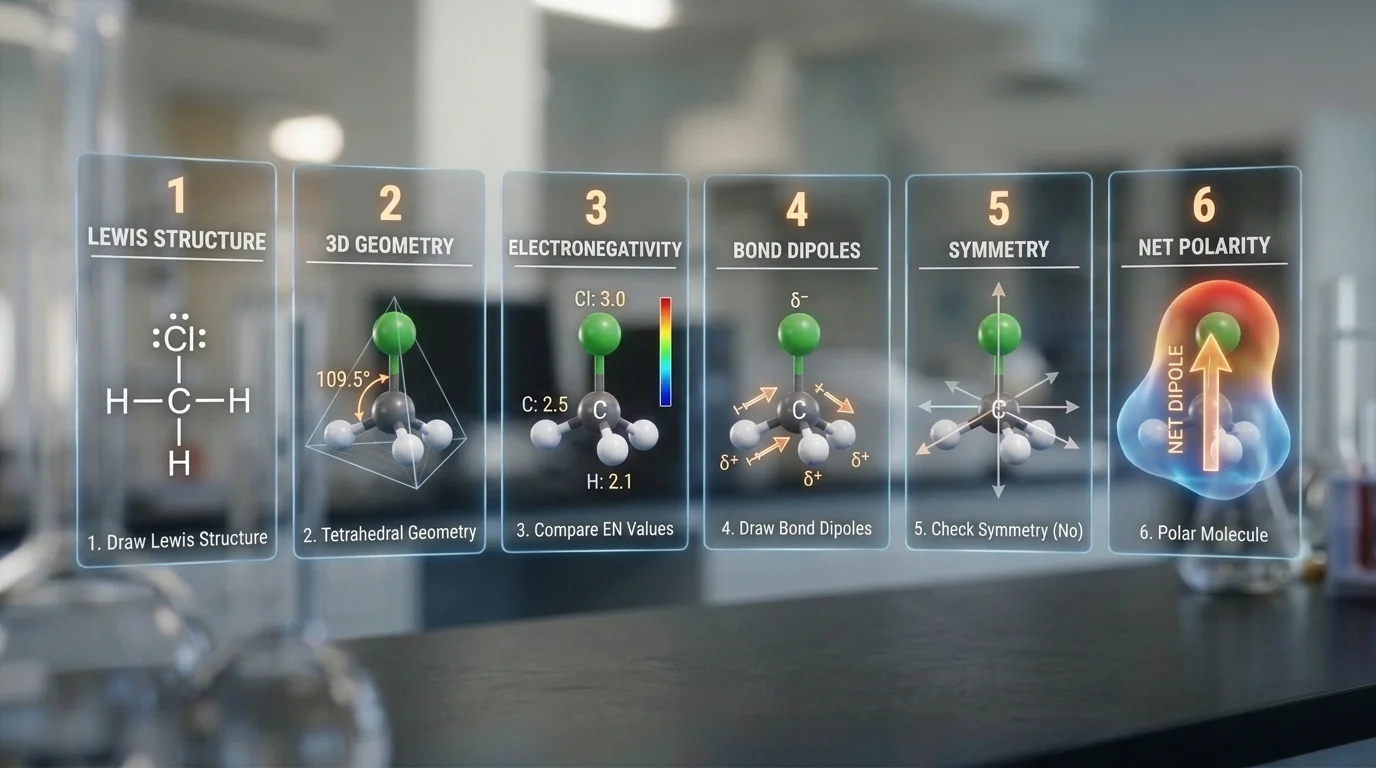
Use this simple method for CH3Cl or any similar molecule.
Step 1: Draw the Lewis structure.
Place carbon in the center, with three hydrogens and one chlorine attached.
Step 2: Identify the molecular shape.
With four groups around carbon and no lone pairs on carbon, the shape is tetrahedral.
Step 3: Check each bond for polarity.
- C–H bonds: small electronegativity difference, only slightly polar.
- C–Cl bond: large electronegativity difference, strongly polar.
Step 4: Check the symmetry of the shape.
Ask: are all four atoms around the center the same? In CH3Cl, no. Three are hydrogen, one is chlorine.
Step 5: Decide if the dipoles cancel.
If the shape is symmetrical and all bonds are the same, dipoles cancel and the molecule is nonpolar. If the shape is uneven, like in CH3Cl, the dipoles do not cancel, and the molecule is polar.
Result for CH3Cl: Uneven shape, strongly polar C–Cl bond, dipoles do not cancel. The molecule is polar.
Common Mistakes with CH3Cl Polarity
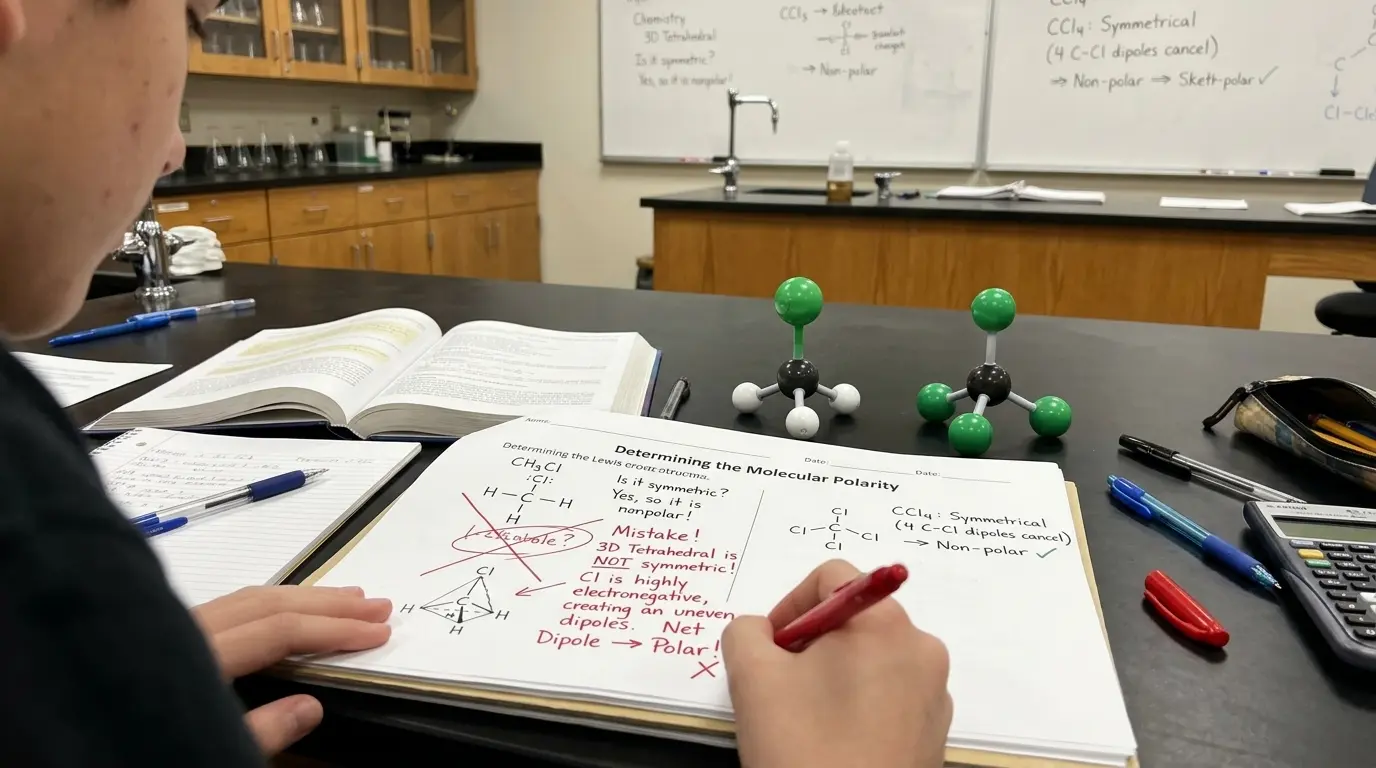
Here are the errors students make most often.
1. Assuming a symmetrical shape always means nonpolar.
- Wrong idea: “CH3Cl has a tetrahedral shape, so it must be nonpolar like methane.”
- Correct idea: The shape is tetrahedral, but the atoms around the center are not all the same, so the molecule is still polar.
2. Only checking bond polarity and ignoring shape.
- Incomplete: “The C–Cl bond is polar, so the molecule is polar.” This happens to be correct here, but the reasoning is incomplete. You always need to check whether the shape allows the dipoles to cancel.
3. Confusing “polar bond” with “polar molecule.”
A molecule can have polar bonds and still be nonpolar overall, if the shape is symmetrical enough for the dipoles to cancel, as in CCl4. CH3Cl does not have this kind of symmetry, so it stays polar.
4. Forgetting to compare with methane.
Many students find it easier to understand CH3Cl by first picturing CH4, then asking what changes when one hydrogen becomes chlorine.
5. Mixing up chloroform and chloromethane.
- CHCl3 is chloroform, with three chlorines and one hydrogen.
- CH3Cl is chloromethane, with one chlorine and three hydrogens.
Both are polar, but they are different molecules with different formulas.
CH3Cl Polarity in Real World Context
- “Determine whether CH3Cl is polar or nonpolar, and explain your reasoning using electronegativity and molecular geometry.”
- “Compare the polarity of CH4, CH3Cl, and CCl4 in a short paragraph.”
In chemistry textbooks and study guides
- “Chloromethane (CH3Cl) is used as an example of how a single electronegative substituent can make a symmetrical shape produce a polar molecule.”
In real-world applications
- CH3Cl was once widely used as a refrigerant, before safer alternatives replaced it.
- It is also used as a solvent and in the production of silicone products.
- Its polarity affects how it dissolves in water and other substances, which matters for its industrial uses and safety handling.
On study and student forums
- “Can someone explain why CH3Cl is polar but CCl4 is not? I thought they’d both be nonpolar since they’re both tetrahedral.”
- “Is CH2Cl2 also polar for the same reason as CH3Cl?”
CH3Cl Polarity Search Trends & Usage Data
I can’t give you exact search numbers here, because they change over time. But the general pattern is clear and easy to check.
What the pattern shows:
- Searches for “CH3Cl polar or nonpolar” spike heavily during the school year, especially around exam periods in general chemistry and organic chemistry courses.
- Related searches often include other molecules from the same family, like “CH2Cl2 polar or nonpolar” and “CCl4 polar or nonpolar,” since students usually study them together.
- This topic is searched worldwide wherever general chemistry is taught, since electronegativity and molecular geometry are core topics in most chemistry curricula.
By context:
- Most searches come from students working on homework, lab reports, or exam review.
- Chemistry tutoring sites and video platforms see high engagement on this exact topic, since visual explanations of molecular shape help clarify the concept quickly.
How to check the latest data yourself:
- Go to Google Trends.
- Type “CH3Cl polar or nonpolar” and compare it with “CH2Cl2 polar or nonpolar.”
- Set a date range that includes the school year, such as September through May.
- Check the “Related queries” box for connected topics like “electronegativity chart” or “molecular polarity rules.”
Why this matters for study content: students usually want a fast, direct answer first, followed by a clear explanation they can use to solve similar problems on their own. The Quick Answer section above is built to meet exactly that need.
CH3Cl and Related Molecules Side-by-Side Comparison
| Molecule | Central Atom Bonds | Symmetry | Polar or Nonpolar |
| CH4 | 4 C–H bonds | Fully symmetrical | Nonpolar |
| CH3Cl | 3 C–H, 1 C–Cl | Not symmetrical | Polar |
| CH2Cl2 | 2 C–H, 2 C–Cl | Not symmetrical | Polar |
| CHCl3 | 1 C–H, 3 C–Cl | Not symmetrical | Polar |
| CCl4 | 4 C–Cl bonds | Fully symmetrical | Nonpolar |
Frequently Asked Questions
Is CH3Cl polar or nonpolar?
CH3Cl is polar. The C–Cl bond is much more polar than the C–H bonds, and the tetrahedral shape does not allow the dipoles to cancel out.
Why is CH3Cl polar if it has a tetrahedral shape?
A tetrahedral shape only produces a nonpolar molecule if all four atoms around the center are identical, like in CH4 or CCl4. In CH3Cl, the atoms are different (three hydrogens and one chlorine), so the shape stays uneven and the molecule remains polar.
Is the C–Cl bond in CH3Cl polar or nonpolar?
The C–Cl bond is polar, since chlorine is significantly more electronegative than carbon.
Is CH4 (methane) polar or nonpolar?
CH4 is nonpolar. All four bonds are identical C–H bonds, arranged symmetrically, so their dipoles cancel out.
Is CCl4 polar or nonpolar?
CCl4 is nonpolar, for the same reason as CH4. All four bonds are identical (C–Cl this time), and the symmetrical shape causes the dipoles to cancel.
What makes a molecule polar overall, not just one bond?
A molecule is polar overall when it has polar bonds arranged in a shape that does not allow the individual bond dipoles to cancel each other out.
Is CH2Cl2 polar or nonpolar?
CH2Cl2 is polar, for the same basic reason as CH3Cl. The mix of hydrogen and chlorine atoms breaks the symmetry needed for the dipoles to cancel.
Conclusion
So, is CH3Cl polar or nonpolar? Now you know the clear answer: CH3Cl is polar.
Here are the key points. The molecule has a tetrahedral shape, but that shape only leads to a nonpolar result when all four atoms around the central carbon are identical. In CH3Cl, one hydrogen is replaced with chlorine, which is far more electronegative. This creates a strongly polar C–Cl bond and breaks the symmetry needed for the bond dipoles to cancel out, leaving the whole molecule with a net dipole.
The same pattern explains related molecules. CH4 and CCl4 are both nonpolar, since all four bonds around carbon match. CH3Cl, CH2Cl2, and CHCl3 are all polar, since their mix of hydrogen and chlorine atoms creates an uneven pull.
When you face a similar question, use the same method every time: draw the structure, identify the shape, check each bond for polarity, and then check whether the overall shape allows the dipoles to cancel. This simple process works for CH3Cl and for almost any other molecule you will study in general chemistry.

Haleema Sadia is a passionate content writer specializing in wishes, greetings, messages, and heartfelt quotes. With 3 years of experience, she creates warm, engaging, and SEO-friendly content that helps readers find the perfect words to celebrate special moments and express their feelings.