
Chemistry students hit this question in almost every general chemistry course: is SO2 polar or nonpolar? The molecule looks simple on paper one sulfur atom, two oxygen atoms but its shape hides a bend that changes everything.
People search for this keyword for a few reasons. Some are checking homework answers. Some are confused because SO2 looks similar to CO2, which is nonpolar, and they expect the same result. Others are trying to understand why polarity matters at all for solubility, boiling point, or reactions.
Here’s the short version: SO2 is polar. The bent shape of the molecule and the pull of electrons toward oxygen create an uneven charge distribution. That imbalance is what makes a molecule polar.
This article gives you the quick answer, the reasoning behind it, common mistakes students make, and real examples of how this fact shows up in everyday chemistry and industry. By the end, you’ll be able to explain SO2’s polarity with confidence not just repeat it.
SO2 – Quick Answer
Sulfur dioxide (SO2) is a polar molecule.
Two things make it polar:
- Bent molecular shape. SO2 has a bent (V-shaped) geometry, not a straight line.
- Unequal charge distribution. Oxygen pulls electron density away from sulfur, creating a partial negative charge on the oxygen atoms and a partial positive charge on sulfur.
Because the molecule is bent, the two S O bond dipoles don’t cancel out. They add up, giving SO2 a net dipole moment of about 1.63 D. That net dipole is the definition of a polar molecule.
Compare this to CO2, which is linear. In CO2, the two bond dipoles point in opposite directions and cancel each other out, making CO2 nonpolar even though it also has polar bonds.
Why Shape Decides Polarity
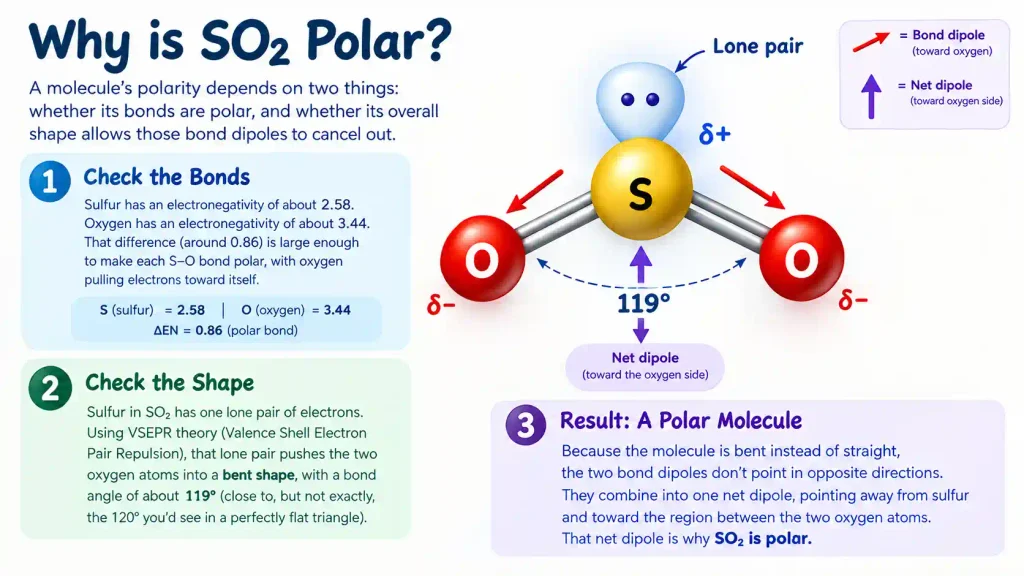
A molecule’s polarity depends on two things: whether its bonds are polar, and whether its overall shape allows those bond dipoles to cancel out.
Step 1: Check the bonds. Sulfur has an electronegativity of about 2.58. Oxygen has an electronegativity of about 3.44. That difference (around 0.86) is large enough to make each S–O bond polar, with oxygen pulling electrons toward itself.
Step 2: Check the shape. Sulfur in SO2 has one lone pair of electrons. Using VSEPR theory (Valence Shell Electron Pair Repulsion), that lone pair pushes the two oxygen atoms into a bent shape, with a bond angle of about 119 degrees close to, but not exactly, the 120 degrees you’d see in a perfectly flat triangle.
Because the molecule is bent instead of straight, the two bond dipoles don’t point in opposite directions. They combine into one net dipole, pointing away from sulfur and toward the region between the two oxygen atoms. That net dipole is why SO2 is polar.
SO2 vs CO2: Why They Behave Differently
Students often compare SO2 to carbon dioxide because both molecules have one central atom bonded to two oxygen atoms. But their shapes are different, and that changes everything.
| Feature | SO2 (Sulfur Dioxide) | CO2 (Carbon Dioxide) |
| Molecular shape | Bent (V-shaped) | Linear (straight) |
| Bond angle | ~119° | 180° |
| Lone pairs on central atom | 1 | 0 |
| Bond dipoles cancel? | No | Yes |
| Net polarity | Polar | Nonpolar |
| Dipole moment | ~1.63 D | 0 D |
CO2’s central carbon atom has no lone pairs, so it forms a straight line. The two C=O dipoles point in exactly opposite directions and cancel out completely. SO2’s sulfur atom has one lone pair, which bends the molecule and stops the dipoles from canceling.
Which Explanation Should You Use?
The right level of detail depends on who you’re explaining this to.
- For a quick homework answer: SO2 is polar because it’s bent, not linear.
- For a lab report or exam: Mention the lone pair on sulfur, the VSEPR-predicted bent geometry, and the resulting net dipole moment (~1.63 D).
- For a general audience or blog reader: Compare it to CO2. People remember contrast better than isolated facts.
- For advanced chemistry courses: Discuss resonance structures, formal charges, and how sulfur’s expanded octet contributes to the bonding picture.
Common Mistakes with SO2 Polarity
Mistake 1: Assuming symmetry means nonpolar, and vice versa. Symmetry matters, but so does shape. A molecule can have identical atoms on both sides (like SO2’s two oxygens) and still be polar if the shape is bent.
Mistake 2: Confusing bond polarity with molecule polarity. Individual S–O bonds are polar. That alone doesn’t tell you if the whole molecule is polar you also need the shape.
Mistake 3: Mixing up SO2 with SO3. Sulfur trioxide (SO3) is trigonal planar and nonpolar, because its three bond dipoles cancel out symmetrically. SO2, with only two oxygens and a lone pair, does not have that symmetry.
Mistake 4: Forgetting the lone pair. Some students draw SO2 as a straight line, missing the lone pair on sulfur that causes the bend. Always count electron groups, not just bonded atoms, when predicting shape.
SO2 in Everyday Examples
- Environmental science: SO2 is a major air pollutant from burning fossil fuels. Its polarity makes it dissolve easily in water, which is part of why it contributes to acid rain.
- Food and wine industry: SO2 is used as a preservative in wine and dried fruit. Its polar nature helps it interact with water-based environments in food products.
- Industrial chemistry: SO2 is a key intermediate in producing sulfuric acid. Its solubility in water, driven by polarity, makes this reaction efficient.
- Classroom examples: Teachers often use SO2 alongside CO2 and SO3 as a set of examples to teach how shape affects polarity.
SO2 – Search Trends & Common Contexts
Searches for “is SO2 polar or nonpolar” spike heavily during the academic year, especially around general chemistry units on molecular geometry and intermolecular forces. It’s one of the most searched polarity questions alongside CO2, water, and ammonia.
Most searches come from students preparing for exams or completing homework, though environmental science students also search this term when studying air pollution and acid rain formation. The comparison with CO2 is one of the most common follow-up searches, since both molecules confuse students who rely on symmetry alone to judge polarity.
Polarity Comparison Table: Common Molecules
| Molecule | Shape | Polar or Nonpolar | Reason |
| SO2 | Bent | Polar | Lone pair causes bent shape; dipoles don’t cancel |
| CO2 | Linear | Nonpolar | No lone pairs; dipoles cancel |
| SO3 | Trigonal planar | Nonpolar | Symmetric shape; dipoles cancel |
| H2O | Bent | Polar | Two lone pairs cause bent shape |
| NH3 | Trigonal pyramidal | Polar | Lone pair creates asymmetry |
| CH4 | Tetrahedral | Nonpolar | Fully symmetric shape |
FAQs
1. Is SO2 polar or nonpolar? SO2 is polar. Its bent shape and unequal charge distribution create a net dipole moment.
2. Why is SO2 polar but CO2 is not? SO2 is bent because sulfur has a lone pair, so its bond dipoles don’t cancel. CO2 is linear with no lone pairs, so its bond dipoles cancel completely.
3. What is the molecular geometry of SO2? SO2 has a bent (V-shaped) molecular geometry, with a bond angle of about 119 degrees.
4. What is the dipole moment of SO2? SO2 has a dipole moment of approximately 1.63 Debye.
5. Is SO3 polar or nonpolar? SO3 is nonpolar. Its trigonal planar shape is symmetric, so the three bond dipoles cancel out.
6. Does SO2 dissolve well in water? Yes. Because SO2 is polar, it dissolves readily in water, forming sulfurous acid. This is part of why SO2 contributes to acid rain.
7. How do you predict if a molecule is polar? Check two things: whether the bonds are polar (based on electronegativity difference) and whether the molecular shape allows the bond dipoles to cancel. If they don’t cancel, the molecule is polar.
Conclusion
SO2 is polar, and the reason comes down to shape. Sulfur’s lone pair bends the molecule, preventing the two S–O bond dipoles from canceling out. That leaves SO2 with a measurable net dipole moment of about 1.63 D.
The easiest way to remember this is through contrast: CO2 is linear and nonpolar, while SO2 is bent and polar, even though both molecules pair a central atom with two oxygen atoms. The lone pair on sulfur is the deciding factor.
For students, the practical takeaway is simple: don’t judge polarity by counting atoms alone. Always check the molecular shape using VSEPR theory, then look at whether the bond dipoles cancel or combine. This same method works for comparing SO2, SO3, CO2, water, and ammonia, a common exam theme.
Understanding SO2’s polarity also explains its real-world behavior, from its role in acid rain to its use as a food preservative. Shape, not just composition, determines how a molecule behaves.